

In 1952, Toy Len Goon, a Chinese immigrant widow raising eight children, was selected as U.S. Mother of the Year by the American Mothers Committee of the Golden Rule Foundation. Her story, celebrated during the Cold War as proof of American democracy, is featured in a new book by Dr. Andrea Louie, Goon’s granddaughter, and professor and chair of Michigan State University’s Department of Anthropology.
Louie’s book, Chinese American Mothering: Toy Len Goon’s Legacy and the Myth of the Model Minority, gives her grandmother the chance to tell her story through her own experiences, not just through the lens of Cold War propaganda. The book uses immigration documents, family interviews, news articles, and secondary sources to illustrate the story of Goon’s struggles and successes alongside the public narrative that framed her as a symbol of democracy triumphing over communism.
“I grew up knowing the story but hadn’t really thought about its larger historical significance,” Louie said. “There are lots of layers and different perspectives that I bring into conversation in the book—not only how my grandmother’s story was told by the media, but also how she told her own story to her family.”
She describes her book as an ethnography of the model minority myth, told through the life of her grandmother, whose story played a role in shaping it.
The book examines how her maternal grandmother’s life was portrayed in the media and used by politicians to promote an image of opportunity in the United States. It also explores the evolution and impacts of the model minority myth, a stereotype created during this time and framed Asian Americans as inherently successful, intelligent and hardworking minorities.
“The danger of the myth is that the stereotype paints Asians as rule-followers who do everything right and succeed—suggesting that other minorities aren’t working hard enough,” Louie said. “It also minimizes the structural challenges that Asian Americans face and oversimplifies and homogenizes their experiences.”
Journey to the United States: A New Chapter in Maine
When Goon was 10-years-old, she was placed with another family—a choice her mother made not only out of financial hardship but from a desire to give her daughter the best chance at success. She married in 1921 and moved to the United States, settling in Maine, where Goon and her husband ran a hand-laundry while raising their eight children. After her husband died in 1941, Goon assumed full responsibility for the family business, managing the laundry and supporting her children.
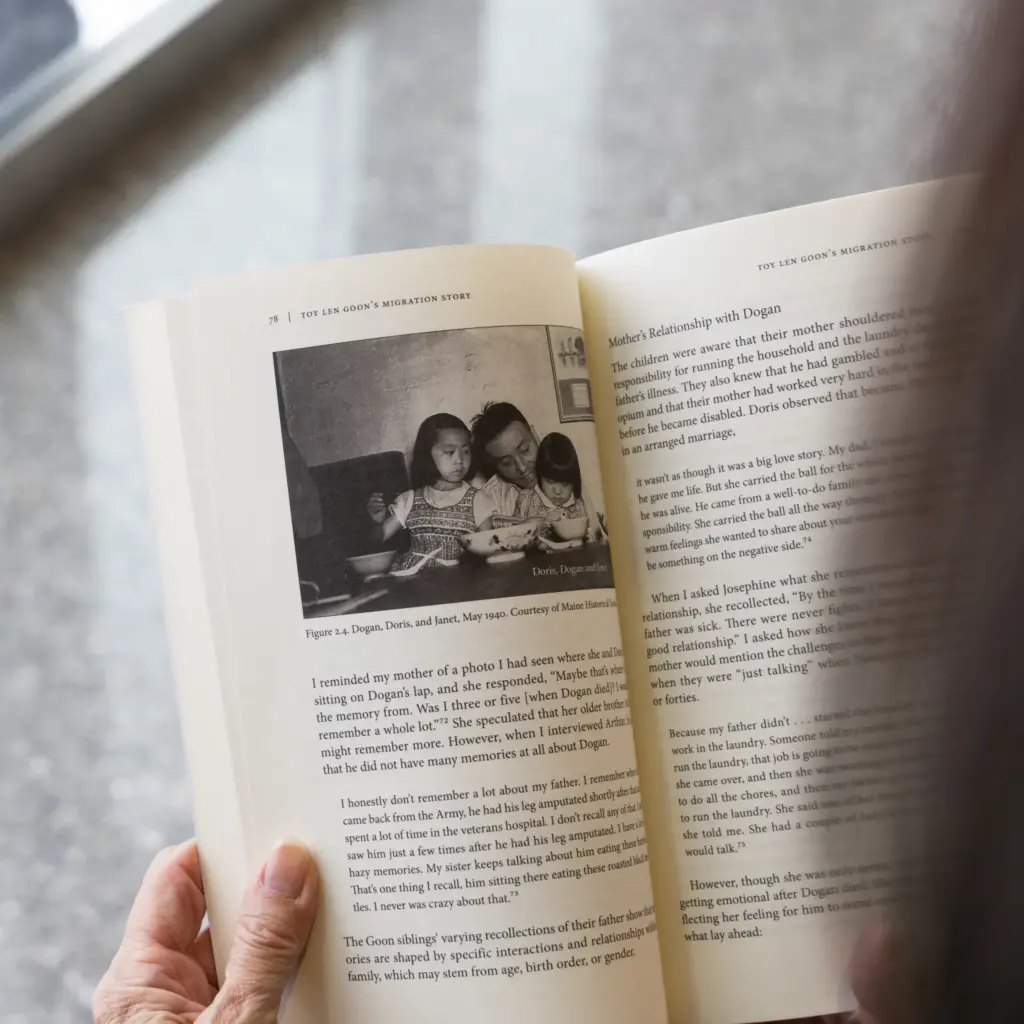
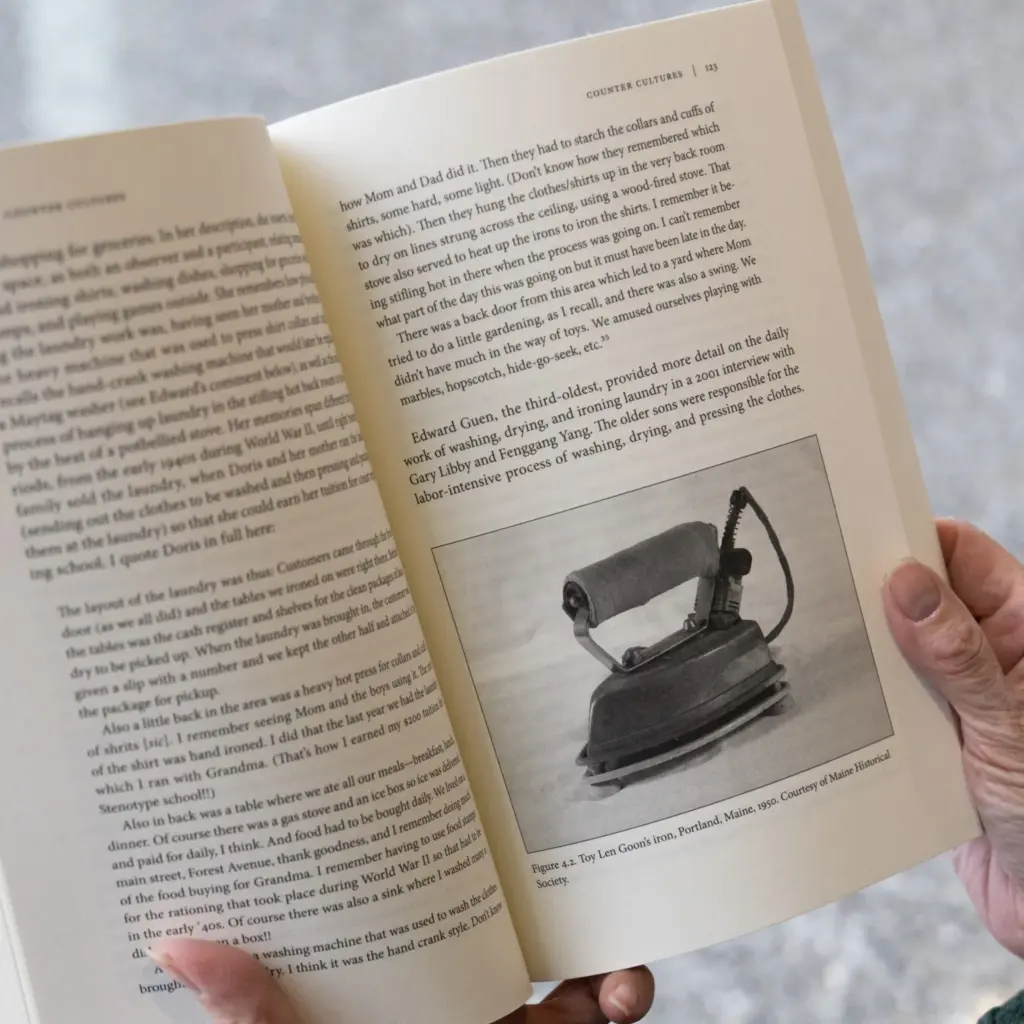
When Goon was named Mother of the Year, Louie said media coverage highlighted specific aspects of her grandmother’s life, including her husband’s veteran status and her role as a businesswoman. Stories also emphasized that she successfully raised eight children who were on their way to professional careers, portraying her as proof of the American dream.
“(Her story) was convenient for the media to highlight a Chinese American widow and her thriving family as proof of U.S. democracy—especially after the communist takeover of mainland China in 1949.” Louie said. “The assumption was that, had Goon and her family remained in China, they would not have fared as well.”
In reality, Louie said their lives were deeply shaped by both the U.S. and Chinese states.
Breaking the myth

Louie discusses how the ‘model minority myth’ still affects Asian Americans today, but has changed over the years. Through interviews with Goon’s children and grandchildren, she sheds light on how the myth has evolved, and how newer versions continue to affect the Goon family. She notes that Goon’s grandchildren push back against the idea of being stereotypically successful model minorities, viewing themselves as different from post-65 immigrants, due to their grandmother’s modest upbringing.
Unlike many recent Asian immigrants who push their children toward top colleges, Goon didn’t realize college was an option for her children until a school principal helped her oldest son, who had taken time off from high school to help in the family laundry, secure a scholarship to Syracuse University.
“My grandmother understood that each grandchild had their own strengths,” Louie said. “She accepted us for who we were instead of expecting us to fit into a single success model.”
In telling her grandmother’s story, Louie hopes readers will see beyond stereotypes and seek to understand the complexities behind the model minority myth, particularly as it is intertwined with broader questions about migration, gender, assimilation, Americanization, and “success.”
“The model minority myth adds a lot of pressure to people,” she said. “It makes them out to be machines, not individuals.”
Louie emphasizes that Toy Len Goon was an extraordinary individual whose story is flattened in its framing by the model minority myth that focused only on her success as an assimilated American mother.
“My grandmother was a forward thinker,” Louie said. “She wasn’t just an American mother — she was also a businesswoman who worked hard to maintain connections to the Chinese American community and to her family back in China.”