
At an inland site in Marquette County, archaeologists have recovered iron scissors, lead shot, kettle fragments, glass beads and a small assemblage of iconographic rings. Radiocarbon dates from charred material and moose bone there average to the 1630s. It is some of the earliest evidence for European-manufactured goods in Michigan.
How those objects got there is not settled. They may have arrived ahead of the Europeans who made them, moving inland along Indigenous exchange networks that were already carrying goods deep into the continent. Dr. Jessica L. Yann writes that ideas about the European newcomers would have circulated along the same routes.
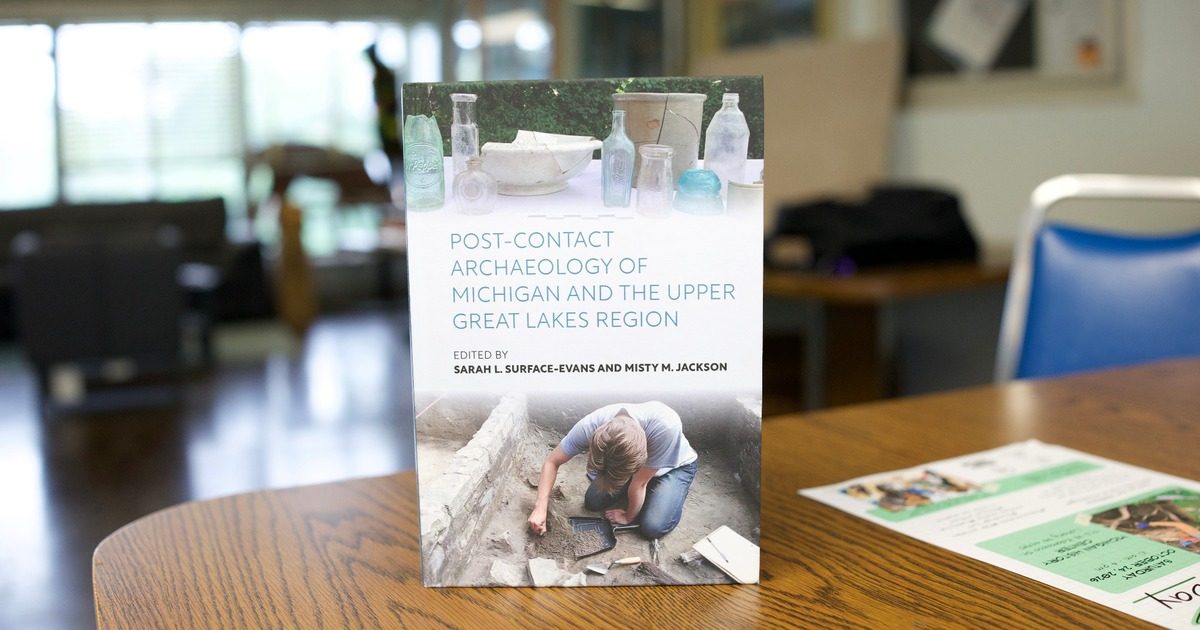
That possibility, that the things arrived before the people, is where Dr. Yann begins her chapter opening Post-Contact Archaeology of Michigan and the Upper Great Lakes Region, published by Berghahn Books. Dr. Yann is Michigan State University’s NAGPRA Program Manager and holds a secondary appointment as an archaeologist in MSU’s Department of Anthropology. She earned her doctorate there in 2019.
Her argument is that “contact” has been asked to do too much work. Used generically, the word compresses two centuries of shifting, uneven, wildly varied relationships into a single event, as though one world ended and another began on a particular afternoon. She does not propose abandoning the term. She proposes breaking it apart.
Four kinds of contact
In place of a single moment, and building on earlier research, Dr. Yann sets out a continuum with four categories. Encroachment covers the earliest period, when European material culture reached Indigenous communities through down-the-line trade rather than face-to-face meeting. Entanglement follows, once Europeans were physically present in small numbers, holding little economic or political power, and the two groups began interacting directly. Symmetrical interaction describes the fort-building era, when colonial powers marked a physical frontier and every group involved had to compromise in order to hold onto its political and economic independence. Shatter zone covers the violence after 1750, through the Seven Years’ War, Pontiac’s Rebellion and the War of 1812, and the Indigenous strategies of resilience and survivance that ran through it.

Dr. Yann is explicit that the categories overlap. People at a single site may have experienced interactions belonging to several at once. The point is not a cleaner set of boxes but a better set of questions about power and economic relationships.
The questions we ask
The chapter’s most concrete work is not in re-dating individual sites but in reframing the questions archaeologists ask, shifting away from settler narratives about which Europeans arrived first and toward a closer examination of how Native communities adjusted and responded to colonial encroachment.
The Cloudman site, in Chippewa County, shows what that shift looks like. Described in 1999 as perhaps the earliest of Michigan’s contact sites, it was reconsidered in later work. A copper knife once read as a Native American reproduction of a French clasp knife turned out to be a native copper knife with a bent tang. Chemical analysis of glass beads from the site pointed to a recipe used between 1670 and 1700. On that reading, Cloudman belongs to the period of entanglement, roughly four decades later than its reputation.
Approached this way, Dr. Yann argues, the questions get more interesting. How Native American communities persisted and adapted reveals more about the chaos of being human than the question of who arrived first.
Her chapter opens an edited volume of nineteen, ranging across the Upper Great Lakes from French trading posts and Great Lakes shipwrecks to twentieth-century Detroit. Several of its contributors trained in or work for MSU’s Department of Anthropology. Dr. Lynn L. M. Evans draws together six decades of research at Fort Michilimackinac. Dr. Sean B. Dunham examines what Odawa cache pits reveal about long-term connections to place. Dr. Stacey Camp, who directs the MSU Campus Archaeology Program, co-wrote a chapter on childhood on the MSU campus with two program alumni. The introduction is free to read on the publisher’s website, and the book is available from Berghahn in hardback and e-book.
Why the word matters
Dr. Yann’s conclusion is that the evidence does not describe one contact event. It describes a series of strategies by Native American communities engaging with Europeans and their material culture on their own terms, in forms that shifted over time. Encroachment, she argues, was a larger and more meaningful process than the field has recognized.
She also turns the argument on archaeologists. Sites from these periods can be hard to recognize, and researchers who do not know what to look for can miss the evidence of Native persistence entirely, reproducing the settler narratives they set out to interrogate. Being reflexive about how those assumptions shape interpretation is, in her framing, part of the work.
She frames the chapter as another step toward recognizing the variety of voices and experiences in the past, and toward a plainer point. As Dr. Yann writes, “contact” does not mean the same thing to everyone all of the time.