
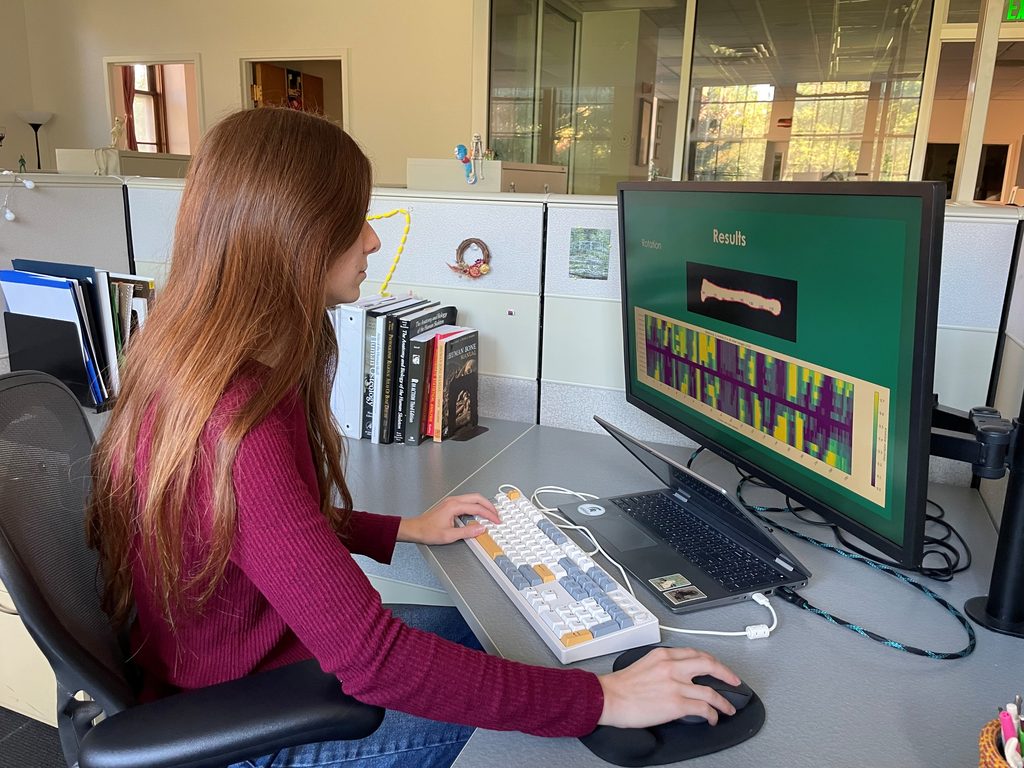
Every morning, Natalie Clark passed through the entrance gate of Offutt Air Force Base, badged through multiple secured doorways, and poured herself a cup of coffee in the break room before finding out what the day would hold. Some days it was the wet lab, screening 80-year-old blankets for bone fragments. Other days it was workshops on blast trauma interpretation or ancestry estimation from teeth. On one, she sat across a table from a woman who had never met her father.
There was no typical day, Clark says. That was one of the reasons she loved it.
Clark, a doctoral student in Michigan State University’s Forensic Anthropology Laboratory, spent the summer at the Defense POW/MIA Accounting Agency (DPAA) in Omaha, Nebraska, through the Naval Research Enterprise Internship Program (NREIP). The Omaha lab is part of the DPAA’s laboratory system, the largest skeletal identification laboratory system in the world, and is accredited by the ANSI National Accreditation Board. The agency’s mission is to provide the fullest possible accounting for U.S. personnel who remain missing, a population currently over 81,000.
Finding the DPAA
Clark came to MSU last year with a background in anthropology and neuroscience but limited experience in forensic anthropology. She had taken relevant courses as an undergraduate, then spent a few years between her bachelor’s and doctoral programs working full-time as a research assistant in a developmental neuroscience lab. Once at MSU, she joined a forensic anthropology listserv to stay connected to the field.
That’s where she first saw the DPAA internship listing.
“Those who are familiar with the forensic anthropology field have heard of the DPAA and know what they do,” Clark says. “Well, I had never heard of them before, but the work sounded super interesting.”
She brought the opportunity to her advisor, Dr. Joe Hefner, associate professor of forensic anthropology, who was excited to see her interest, Clark says. What she didn’t know at the time was that Hefner had worked at the DPAA himself for several years before joining MSU.
Hefner wanted to hear what drew her to the work. Once she told him, he encouraged her to apply for the highly competitive internship. Ultimately, Clark was one of the two interns selected for the Omaha lab.
Inside the lab
Clark’s work at the DPAA ranged widely. Remains arrive at the Omaha lab through honorable carry ceremonies, formal processions in which military personnel receive transfer cases from cargo planes. Once a case was opened, the team would remove remains that had been wrapped in blankets at the time of burial, sometimes 80 years earlier. Clark’s job was to X-ray each blanket bag, then screen the soil and fabric for bone fragments that might have been missed.
“Screening consisted of unrolling the blanket, if it still had any structure left to it, and putting the clay, mud and dirt on a screen,” Clark says. “I would then pour a steady stream of water on top to let the soil run through and leave anything bigger behind.”
Other days were devoted to workshops: three- or four-hour sessions with DPAA anthropologists on topics ranging from estimating ancestry from teeth to interpreting blast trauma from aircraft crashes. Clark also tried her hand at the skeletal competency exam that every DPAA forensic anthropologist must pass before being assigned casework, using it as a benchmark for her own skills before she began helping with cases.
On quieter days, she would approach analysts on the lab floor and ask to help. She pair-matched clavicles from the Enoura Maru project, helped reassociate and organize bone fragments, and assisted analysts with active cases. She also worked alongside the lab’s other intern, Jasmine Hernandez, and the two became friends.
“At the end of every day, I was exhausted, but in a good way,” Clark says.
How much difference is too much?
Clark also conducted an independent research project during the internship, an experience she says taught her how to develop an idea from the ground up.
The idea started at MSU’s own Forensic Anthropology Laboratory. Clark’s lab had a set of skeletonized remains with a presumptive identification, meaning they had a strong guess about who the person was and needed to prove it. They obtained the individual’s medical records, which included a chest X-ray taken while the person was alive. The lab team positioned the vertebrae and took a new X-ray. The images didn’t match.
“Our conclusion was that we were wrong, and the person we thought we had is actually someone else,” Clark says. “Then along comes Dr. Hefner, who repositioned the vertebrae in a dramatic angle to best represent what the positionality would have been when they were getting the chest X-ray, and boom. It was a match.”
The initial positioning had been so far off that the radiographs looked like they came from two different people. Clark started wondering: how much of a difference in positioning is too much?
At the DPAA, she designed a study to answer that question. Her project, “Postmortem Clavicle Positioning,” asks whether changes in the angle or rotation of a bone can make X-rays of the same clavicle look different enough to complicate a match between postmortem and antemortem radiographs. To test this, she X-rayed clavicles at systematically varied angles and positions, then analyzed the shape differences using quantitative methods, including elliptical Fourier analysis and shape context. She also created a survey asking forensic anthropologists of varying experience to identify images of the same clavicle across different positions.
If her results hold up, the work could eventually help analysts determine how much positional variation they can tolerate when comparing radiographs, potentially reducing the number of postmortem X-rays needed for a given case. Clark presented preliminary findings at a DPAA staff meeting and intends to submit her research to the 2027 American Academy of Forensic Sciences conference in Orlando, Florida, with the goal of eventually publishing it as a manuscript.
“Not a dry eye in the room”
Beyond the lab work, Clark participated in experiences that connected the science to the people it serves.
She took part in multiple honorable carry ceremonies. Clark helped remove coverings and ratchet straps from each case, then stood silently outside the aircraft as they were unloaded one at a time by military personnel.
“It was a phenomenal honor being part of the team that welcomed the service members home after roughly 80 years,” Clark says.
She also attended the Korean/Cold War Annual Government Briefing, where families of unaccounted-for servicemembers hear updates from DPAA historians, analysts and leadership, and have the chance to ask questions directly. South Korea sent representatives as well, as the country is establishing its own lab to identify its war dead.
After the formal presentations, family members spoke about their lost relatives. “There was not a dry eye in the room,” Clark says. “Even though decades have passed, the connection to their family remains strong and furthers the motivation for the DPAA to keep doing what they’re doing.”
Clark and Hernandez were invited to sit in on a meeting between a family member and her Casualty Service Officer. The woman, whose father died when she was only a few months old, shared photographs of him. Historians had gathered new information, and among their findings was evidence suggesting her father had known about her birth.
“That little piece of information was enough to provide some comfort to the daughter,” Clark says.
Looking ahead
Clark credits a network of mentors and programs with making the experience possible. Hefner’s decision to take her on as a doctoral student, she says, opened the door to every opportunity she has had at MSU. She also credits MSU’s Forensic Anthropology Laboratory and the Early Start Program, which supports graduate students’ research and professional development outside the regular academic year.
At the DPAA, she thanks Dr. Rylan Tegtmeyer Hawke, her mentor at the Omaha lab, for facilitating her experiences there. She also thanks Dr. Carrie Brown, lab manager, and Dr. Franklin Damann, lab director, for accepting her as an intern and treating her like a colleague.
“I am becoming an independent scientist, have created meaningful connections with experts in the field, and have gained skills as a forensic anthropologist as well as a professional collaborator,” Clark says.
She returned to MSU with plans to continue developing her clavicle positioning research and with a reinforced conviction about the collaborative nature of identification work.
“I am not exaggerating when I say every single person I interacted with at the DPAA was fantastic,” Clark says. “Very welcoming, excited to answer questions, and overall fun and genuine people to talk to. I will forever treasure the time I spent there. And who knows, perhaps I’ll be back.”