• Access Spotlight: Dr. Kehli Henry

    Access Spotlight: Dr. Kehli Henry

    Kehli Henry, Ph.D., is Michigan State University’s Access Spotlight honoree. During the month of November the college celebrates the diverse history, culture and accomplishments of our Native American and Indigenous community members. There are over 500 federally recognized tribes across the country including a dozen in the state of Michigan, each with its own unique set of shared traditions, language and customs. Henry is a proud Anishinaabekwe (Ojibwe woman), and as a researcher who has worked closely with Native American communities striving to increase awareness and improve access to a wide range of public services and programming, she is a shining example of an Access Spotlight. 

    Click here to learn more about Henry and her work.

    By Louise Henderson

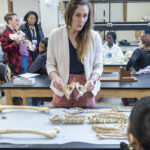
  • Associate Professor Dr. Joe Hefner receives $2 Million Dollar Grant from the Department of Justice

    Associate Professor Dr. Joe Hefner receives $2 Million Dollar Grant from the Department of Justice

    The Department of Anthropology is pleased to announce that Associate Professor Dr. Joe Hefner has been awarded $2,062,069 from the Department of Justice for a project entitled MOSAIC: Unifying Methods of Sex, Stature, Affinity, & Age for Identification through Computational Standardization.

    To aid in the identification of unknown human remains, forensic anthropologists are often called upon to create a biological profile, or an estimation of the unknown individual’s age, biological sex, population affinity (i.e., ancestry), and stature. The data collected to develop a biological profile typically includes both metric and nonmetric/morphological data from across the entire skeleton, and these data are then analyzed using a variety of analytical methods. These methods are each based on different subsets of data (e.g., cranial metrics for population affinity estimation versus innominate morphology for sex estimation), with multiple methods available to estimate each parameter of the biological profile. However most currently available methods analyze only a single data modality (metric v. nonmetric), focus on only a single skeletal element (e.g., cranium v. innominate), and can only estimate a single biological profile parameter. This leaves forensic anthropologists with a bewildering array of methods that may produce idiosyncratic results, with no evidence-based way to determine how differing results should be weighed or reported. Further, fragmenting methods by individual biological profile parameters ignores the realities of human skeletal variation, creates a priori assumptions about which data provide information for which parameter, and fails to account for interactions between sex, population affinity, age, and stature.

    MOSAIC, or Methods of Sex, Stature, Affinity, & Age for Identification through Computational standardization, is a proposed non-proprietary computer program that will produce a holistic estimation for all biological profile parameters. This program will use a machine learning (ML), artificial intelligence (AI) system built using a large database of contemporary skeletal data. The innovations of MOSAIC are (1) the creation of a dataset that encompasses trait and measurement data from the entire skeleton that spans multiple biological profile methods (“matched data”) and (2) the use a robust ML/AI approach to uncover new patterns of interaction within the data, while minimizing variability between practitioners. Preliminary data show that the alpha version of MOSAIC significantly outperforms the most commonly used methods to individually estimate sex and population affinity, as well as a combined sex and population affinity estimation. The use of a reference sample of matched data and non-partitioned approach addresses pitfalls in traditional approaches, while also standardizing the analytical process of biological profile estimation.

    By Ethan Watrall

  • New faculty member Dr. Madeline Mackie’s work at the La Prele Mammoth site is featured in this quarter’s American Archaeology magazine

    New faculty member Dr. Madeline Mackie’s work at the La Prele Mammoth site is featured in this quarter’s American Archaeology magazine

    New faculty member Dr. Madeline Mackie’s work at the La Prele Mammoth site is featured in this quarter’s American Archaeology magazine. The approximately 12,900-year-old site contains the remains of a butchered Columbian mammoth and at least four camp areas thought to be associated with the animal’s butchery. The presence of an associated camp is particularly notable as there are only two other proboscidean (mammoth and their kin) butchery sites in North America where camps have been identified. In addition to stone tools and animal remains, the site has produced a suite of artifacts including a bone bead and needles, some of the oldest south of the Pleistocene ice sheets, and a large stain of ocher, a natural red pigment. The site is helping archaeologists understand what life was like for the Ice Age residents of the continent.

    Link to online version of the article: https://www.thearchcons.org/la-prele-creek-dig-finds-clovis-camps-oldest-bead-in-north-america/

    By Ethan Watrall

  • Associate Professor Dr. Elizabeth Drexler named Diversity Champion by the College of Social Science

    Associate Professor Dr. Elizabeth Drexler named Diversity Champion by the College of Social Science

    The Department of Anthropology is pleased to announced that Associate Professor Dr. Elizabeth Drexler has been named Diversity Champion by the College of Social Science. Dr. Drexler has worked for decades as a researcher and an educator to understand cultural and historical issues linked to human rights and social justice.

    To learn more about the award and Dr. Drexler’s work, visit https://socialscience.msu.edu/news-events/news/2024-08-21-3.html

  • Honoring Dr. Bernard Gallin (1929-2023)

    Honoring Dr. Bernard Gallin (1929-2023)

    The Michigan State University Department of Anthropology is sad to announce the passing of Professor Emeritus Dr. Bernard Gallin.  Dr. Gallin passed away at the age of 94 on December 16th, 2023.  Dr. Gallin taught, conducted research, with the Department of Anthropology from 1962 until his retirement as Professor Emeritus in 2002, and for 15 years served as the Anthropology department chair.

    Dr. Gallin received a B.S. from City College of New York in 1951, followed by beginning graduate studies at Cornell University. After only one year his studies were interrupted by the Korean War, as he was drafted and assigned to work in Tokyo, Japan, as an expert on China. After completion of service in 1954, he began fieldwork in Taiwan with his wife and lifelong research partner Dr. Rita Gallin (MSU Professor Emerita of Sociology).

    Dr. Gallin was the first Western anthropologist to do a Taiwanese village ethnography, and he and his wife continued to research and publish on Taiwan during their career and after retiring. The lifelong study of Taiwan culminated in the Gallins receiving Honorary Taiwanese citizenship in 2006. The Annual Endowed Bernard Gallin Lecture in Asian Anthropology series was named in Dr. Gallin’s honor after his retirement from the Department of Anthropology.

    Dr. Gallin is survived by his wife and MSU Professor Emerita of Sociology Dr. Rita Gallin, sons Marc and Peter, daughter-in-law Patricia, nieces, nephews, and a wide circle of family and friends.

    For Dr. Gallin’s faculty profile, click here.

    For Dr. Gallin’s online memorial, click here.

  • New Book by Associate Professor Dr. Elizabeth Drexler: Infrastructures of Impunity: New Order Violence in Indonesia

    New Book by Associate Professor Dr. Elizabeth Drexler: Infrastructures of Impunity: New Order Violence in Indonesia

    Department of Anthropology Associate Professor Dr. Elizabeth Drexler announces the publication of her new book, Infrastructures of Impunity: New Order Violence in Indonesia, available now from Cornell University Press.

    From the publisher’s website: In Infrastructures of Impunity Elizabeth F. Drexler argues that the creation and persistence of impunity for the perpetrators of the Cold War Indonesian genocide (1965–66) is not only a legal status but also a cultural and social process. Impunity for the initial killings and for subsequent acts of political violence has many elements: bureaucratic, military, legal, political, educational, and affective. Although these elements do not always work at once—at times some are dormant while others are ascendant—together they can be described as a unified entity, a dynamic infrastructure, whose existence explains the persistence of impunity. For instance, truth telling, a first step in many responses to state violence, did not undermine the infrastructure but instead bent to it. Creative and artistic responses to revelations about the past, however, have begun to undermine the infrastructure by countering its temporality, affect, and social stigmatization and demonstrating its contingency and specific actions, policies, and processes that would begin to dismantle it. Drexler contends that an infrastructure of impunity could take hold in an established democracy.

    The book is available directly from the publisher here. Use the code 09BCARD for 30% off.

    From the publisher’s website: In Infrastructures of Impunity Elizabeth F. Drexler argues that the creation and persistence of impunity for the perpetrators of the Cold War Indonesian genocide (1965–66) is not only a legal status but also a cultural and social process. Impunity for the initial killings and for subsequent acts of political violence has many elements: bureaucratic, military, legal, political, educational, and affective. Although these elements do not always work at once—at times some are dormant while others are ascendant—together they can be described as a unified entity, a dynamic infrastructure, whose existence explains the persistence of impunity. For instance, truth telling, a first step in many responses to state violence, did not undermine the infrastructure but instead bent to it. Creative and artistic responses to revelations about the past, however, have begun to undermine the infrastructure by countering its temporality, affect, and social stigmatization and demonstrating its contingency and specific actions, policies, and processes that would begin to dismantle it. Drexler contends that an infrastructure of impunity could take hold in an established democracy.

  • Campus Archaeology Program Uncovers Foundations of MSU’s First Observatory

    Campus Archaeology Program Uncovers Foundations of MSU’s First Observatory

    Discovery gives insight into campus history, provides educational opportunities

    In summer of 2023, workers from Michigan State University Infrastructure Planning and Facilities, or IPF, were installing hammock posts close to student residence halls near West Circle Drive when they encountered a hard, impenetrable surface under the ground.

    Believing it to be either a large rock or building foundation, IPF called MSU’s Campus Archaeology Program, or CAP. After cross-checking old maps, campus archaeologists determined that it was the foundation of the first observatory on MSU’s campus, constructed in 1881.

    “The campus archaeology program is designed to protect and mitigate our below ground heritage here at MSU,” said Stacey Camp, director of CAP and associate professor of anthropology at MSU, “We collaborate with IPF on construction projects and we are involved in preplanning stages to ensure that if they potentially hit an archaeological site, we can protect it in some manner.”

    The observatory discovery gives insight into how scientific observation, as well as life on campus, has changed over the last 140-plus years.

    “It gives us a sense of what early campus looked like in the late 19th century,” said Ben Akey, MSU campus archaeologist and anthropology doctoral student. “The original campus observatory was built and used at a time when Michigan Agricultural College — what would become MSU — was a radically different institution with only a handful of professors and a relatively small student body.”

    “It gives us a sense of what early campus looked like in the late 19th century,” said Ben Akey, MSU campus archaeologist and anthropology doctoral student. “The original campus observatory was built and used at a time when Michigan Agricultural College — what would become MSU — was a radically different institution with only a handful of professors and a relatively small student body.”

    Akey’s role entails collaborating with IPF to keep up with campus construction projects, researching any discoveries and supervising crews of students participating in on-campus archaeological dig sites. Working closely with MSU Archives, Akey conducted most of the research to confirm that IPF’s discovery was indeed the foundation of the first campus observatory. They also drew on the book “Stars Over the Red Cedar” by Horace A. Smith, professor emeritus in the MSU Department of Physics and Astronomy for additional information.

    “I did a lot of reading to learn more about the first observatory: its history, how it was used and what the building itself might have looked like,” Akey said.

    Astronomical observation at MSU: Then and now

    Located just behind what is now Wills House, the first observatory on MSU’s campus was built by Professor Rolla Carpenter. An 1873 graduate of Michigan State Agricultural College, Carpenter returned as a professor and taught a wide variety of courses, including mathematics, astronomy, French and civil engineering.

    “In the early days of MSU’s astronomy program, Carpenter would take students to the roof of College Hall and have them observe from there, but he didn’t find it a sufficient solution for getting students experience in astronomical observation,” Akey said. “When MSU acquired a telescope, Carpenter successfully argued for funding for a place to mount it: the first campus observatory.

    Individuals pose outside of MSU’s first observatory, circa 1888. The observatory is located behind where Willis House now stands on MSU’s campus, just south of Grand River in North Neighborhood. Photo courtesy of Michigan State University Archives and Historical Collections.
    Individuals pose outside of MSU’s first observatory, circa 1888. The observatory is located behind where Willis House now stands on MSU’s campus, just south of Grand River in North Neighborhood. Photo courtesy of Michigan State University Archives and Historical Collections.

    Today, the MSU observatory is located just south of campus at the intersection of Forest and College roads. It boasts a 24-inch telescope and is used for undergraduate and graduate education and research, as well as faculty research. It also hosts free public observation nights.

    Levi Webb is a fourth-year astrophysics and anthropology major who works at MSU’s current campus observatory and participated in the archaeological dig of the first on-campus observatory.

    “It’s amazing to see how far we’ve come from a little 16-foot circular building to a large building with a high-quality telescope and an electric dome,” Webb said. “Seeing the difference between how observing used to be versus how it is now is very interesting to me and makes me appreciative of the observatory we have now.”

    Real-world experience: Field school and summer digs

    While most students who work with campus archaeology are anthropology majors, some — like Webb — have backgrounds in other areas of study. In addition to Webb, the observatory dig crew included students majoring in classical and romance studies and forensics.

    “Having students from majors outside anthropology gives us a different perspective on what we’re finding in the ground,” said Camp. “We feel really lucky to have a wide variety of knowledge on our dig sites.”

    Akey said working on a dig site, such as the first campus observatory, helps prepare students for careers in archaeology.

    “CAP provides an essential venue of professional training for both graduate students and undergraduates in archaeological fieldwork in analysis,” Akey said.

    One training opportunity is an undergraduate field school led by CAP. Most archaeology and anthropology programs require fieldwork, which is often done overseas and can often be costly. Every other summer, MSU hosts a field school that gives Michigan students who are interested in archaeology, but may not have the financial resources to travel abroad, an opportunity to do hands-on work on an actual site.

    For the upcoming field school in 2024, CAP is planning to focus on the first observatory site.

    “Next summer, we’re planning to run an undergraduate archaeological field school where students can enroll for credit and get experience excavating the foundation of the first observatory on campus,” Camp said. “We anticipate having 18 to 20 students work on the project and get great experience doing archaeology.”

    Camp said seeing students develop an interest in connecting the past with the present energizes her.

    “I love watching students connect with artifacts and try to tell a bigger story about humankind with those objects,” she said.

    Connecting past and present

    Akey said they appreciate the unique opportunity to learn more about MSU’s campus history while developing skills that will serve them beyond the completion of their Ph.D.

    “One of the things I value most about archaeological work is kind of building a sense of connection to landscapes and people,” they said. “With a campus this old, there’s a lot of historic materials, archaeological materials that would be disturbed by all the ongoing construction on campus. Because of our partnership with IPF, those objects are not disturbed, and we get a chance to document and analyze some of them. It’s a pretty cool job.”

    Camp was initially drawn to archaeology as a tactile way to interact with history and gain new perspectives.

    “Archaeology gives us a bit more knowledge about how people lived in the past, how they did things differently and how maybe we could do things differently in the contemporary world as well,” she said.

    Webb sees this firsthand through his work at the observatory and on archaeological dig sites.

    “In my job working outreach at the observatory, I meet people who graduated from MSU many, many years ago who come and see the work that we’re doing, and they’re very proud to see how campus has grown,” he said. “I have even more insight into the campus’ evolution after learning about the first observatory and the history of scientific observation on campus.”

    Camp said she feels honored to connect MSU’s past to its present through her work with CAP.

    “MSU is a passionate and dedicated community,” she said. “Spartans are very invested in this campus and its history, and being able to share a little bit of my knowledge with people is very rewarding.”

    View more images from the dig site here.

  • MSU Biomarker Laboratory for Anthropological Research is seeking mid-Michigan breastfeeding mothers for upcoming study

    MSU Biomarker Laboratory for Anthropological Research is seeking mid-Michigan breastfeeding mothers for upcoming study

    Department of Anthropology Associate Professor Masako Fujita, Director of the MSU Biomarker Laboratory for Anthropological Research, is looking for mid-Michigan breastfeeding mothers to volunteer for an upcoming study, “Exploring Human Milk Immune Specificity.”

    Qualifying volunteers will be asked to:

    • Come to Michigan State University East Lansing campus, if possible, with baby – about 2 hours
    • Pump about one ounce of milk (in a private office) and give blood drops via finger stick
    • Answer questions and have their body measurements taken
      We ask volunteers to pump milk at campus, rather than donating frozen milk, to be sure that all the immune factors in milk are still active when we take it into the lab. Participants will receive a $35 Amazon gift card. For more info please email masakof@msu.edu.
  • Associate Professor Heather Howard named the recipient of the 2023 College of Social Science Diversity, Equity and Inclusion Excellence Award

    Associate Professor Heather Howard named the recipient of the 2023 College of Social Science Diversity, Equity and Inclusion Excellence Award

    Associate Professor of Anthropology Dr. Heather Howard has been named the College of Social Science’s recipient of the Diversity, Equity, and Inclusion (DEI) Award. This award recognizes a faculty member who plays a leadership role in advancing diversity, equity, and inclusion by demonstrating activities which may include serving underrepresented populations, developing or implementing innovative programs that enhance participation and opportunity, or enhancing the ability and effectiveness of the College to be an inclusive and welcoming environment.

    The Office of the Associate Dean for Diversity, Equity, and Inclusion offers the Dean’s Diversity and Inclusion Excellence Awards once every two years. On even years, staff and graduate students receive awards. On odd years, faculty and undergraduate students receive awards.

    “I think the award really brings attention to something that’s even more important than ever, to amplify the value of diversity,” Howard said.  

    “It’s due to our diversity and our capacity to learn from our diversity that has led us to be where we are. I think if we weren’t adaptable to change, and exercising our capacity to learn, we wouldn’t be around right now. Diversity is so fundamental to the flourishing of human beings, and we need to really play to that human strength.” 

    Howard has been a faculty member in the department of Anthropology since 2009. Before that, she was a visiting Ph.D. fellow and instructor from 2002 to 2004 and was an adjunct faculty member from 2007 to 2008. She has dedicated her career and research to advancing DEI efforts. She was recognized with the College of Social Science Diversity Champion Award in 2021. Howard was previously recognized as an Exemplary Diversity Scholar, National Center for Institutional Diversity in 2010 and was the Outstanding Faculty Award recipient from the MSU Resource Center for Persons with Disabilities in 2008.  

    “I have a genuine interest and honesty in wanting to learn from other people, no matter what their background, and to really elevate that in the classroom as something that all the students understand so that they can learn from each other, and that everybody has something important to contribute,” Howard said.  

    Howard primarily works with Indigenous communities and her research focuses on addressing social and structural inequities. Her research is carried out in a variety of settings including community centers, museums, clinics, and schools. 

    “My commitments to diversity, equity, and inclusion (DEI) excellence are integrated across my research, teaching, and service, which are centered on Indigenous community-identified priorities that cohere around decolonizing well-being and intersectional justice,” Howard said.

    “My career centers on collaborative, Indigenous community-driven scholarship firmly grounded in Indigenous knowledge frameworks, solid relationship building, and the advancement of research meaningful to communities. This service to Indigenous communities is fundamental to every dimension of my work as a scholar, not because it sustains the trust needed to carry out research with Indigenous communities, but because it informs my responsibilities to serve the transformation of environments to be inclusive, value diversity, advance social justice, and support others in the realization of their full potential. This therefore extends to my work beyond Indigenous communities to the systems of social and cultural services, healthcare, and education that are usually the sites of my research.” 

    Howard hopes she can inspire other professors and colleagues to be more inclusive while diversifying their research. 

    “There is so much work that needs to be done to help people open their minds and realize how their work can be diversified, how they can be inclusive, how their work can be oriented towards social justice.” 

    Within the Department of Anthropology, Howard has recommended that professors create their own DEI statements, so students feel more included and welcome. 

    “I thought this might serve as a personal guide for individuals to identify how they might strive to meet DEI goals in their research, teaching, and service, and encourage conscious integration and personal reflection to get there.”

  • Society of Antiquaries elects first MSU professor Dr. Ethan Watrall as fellow 

    Society of Antiquaries elects first MSU professor Dr. Ethan Watrall as fellow 

    The Society of Antiquaries elected Dr. Ethan Watrall, associate professor in the Michigan State University Department of Anthropology, as a fellow. The Society of Antiquaries was founded in 1707, and represents the oldest learned and prominent scholarly society focusing on heritage and archaeology. The society’s 3,000 elected members include some of the most prominent scholars and professionals in heritage and archaeology such as national museum directors, curators, directors of heritage preservation trusts and non-profits, and members of the UK parliament. Dr. Watrall is the first MSU professor to have ever been granted this distinction, only the fourth elected from the Big 10, and the ninth from the United States. 

    “Being named a Fellow of the Society of Antiquaries is enormously important to me as it is a recognition of the importance of my work to the fields of heritage and archaeology,” Dr. Ethan Watrall said. “It also reflects very well on the Department of Anthropology by shining a spotlight on the outstanding research, teaching, and outreach we’re doing in heritage, preservation and community engagement.”  

    Dr. Watrall was elected due to the notoriety of his research, teaching and outreach in the use of digital methods and computational approaches to document, preserve, contextualize, and provide access to tangible heritage and archaeology. 

    “I strive to leverage digital methods to preserve and provide access to archaeological and heritage materials, collections, knowledge, and data in order to facilitate research, advance knowledge, fuel interpretation, and democratize understanding and appreciation of the past.”

    In most cases, his research leans towards providing a mechanism for the public to engage with and understand our collective heritage.

    “But it’s not just about public access to digitized heritage,” he explained. “My work also focuses on collaborating with communities to digitize their own heritage and tell their own stories about their past with that digitized heritage. A lot of my work also intersects with museums and other collections holding heritage institutions, building workflows and platforms to digitize, provide access to, and contextualize natural and cultural collections that are often completely inaccessible to the public, communities, students, and scholars.” 

    While Dr. Watrall has directed or co-directed many externally funded digital heritage and archaeology projects, a recent example of his work in this area is the Internment Archaeology Digital Archive (IADA), which he co-directs with his Department of Anthropology colleague Dr. Stacey Camp. Currently funded by the National Park Service and developed in collaboration with MSU’s Matrix: The Center for Digital Humanities and Social Sciences, IADA is an open digital archive that will host, preserve, and provide broad public access to digitized collections of archaeological materials, archival documents, oral histories and memorabilia that speak to the experiences of Japanese Americans incarcerated during World War II in the United States.

    “A significant amount of the digitization work on this project is happening in my lab at MSU (Digital Heritage Innovation Lab), including using various techniques to create 3D scans of artifacts and objects from two sites of internment and incarceration – the Minidoka National Historic Site (the site of Minidoka War Relocation Center) and the Kooskia Internment Camp While IADA is primarily designed to address the immediate needs of Kooskia and Minidoka’s descent communities, Japanese Americans, and scholars of Asian American studies and incarceration, the project’s audience extends well beyond these groups. In its broadest, IADA provides testimony and material evidence of the trauma wrought by incarceration and discrimination.”

    Additionally, the focus of Dr. Watrall’s teaching helps to prepare future generations of Anthropologists to engage in digital methods and computational approaches to preserve heritage. He regularly teaches ANP 412: Methods and Practice in Digital Heritage and ANP 465: Field Methods in Digital Heritage – the only class of its kind in the U.S. 

    “Beyond my curricular efforts, I also direct the Cultural Heritage Informatics Initiative, which provides graduate students interested in cultural heritage with the space to learn how to apply digital methods and computational approaches to their work,” he said.  

    Dr. Watrall also seeks to share digital practices with the field of Anthropology across a wide scale. He recently published two edited volumes (co-edited with Dr. Lynne Goldstein, professor emerita of Anthropology) with University Press of Florida. The volumes, Digital Heritage and Archaeology in Practice: Data, Ethics, and Professionalism and Digital Heritage and Archaeology in Practice: Presentation, Teaching, and Engagement, are the outcomes of the National Endowment for the Humanities Funded Institute for Digital Archaeology Method & Practice which he co-directed with Dr. Goldstein some years ago. 

    All new fellows are formally admitted to the society during a ceremony at Burlington House, the society’s headquarters in London, where they sign the register of admissions and are welcomed into the society. Dr. Watrall hopes to attend the ceremony the next time he’s in London. 

    “It is my hope that the being named a fellow will help greatly increase the number of graduate students wanting to come to MSU to work with me and my colleagues in the department, provide more opportunities to secure external funding to support our work, provide more opportunities for innovative collaboration with other scholars and units around campus, and encourage the college and university to invest more resources in our work and allow us to grow and extend our reach and impact.” 

    To learn more about the MSU Department of Anthropology, visit anthropology.msu.edu.