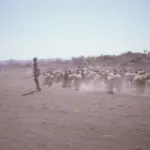
Young boys herding goats and cattle in northern Kenya.
“During a severe drought, we found that mothers protect both their own nutrition and the nutrients in their breast milk—safeguarding their babies—through a combination of social support, behavioral choices, and biological responses,” Fujita said.
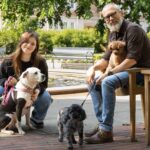
Savannah Holcombe, doctoral student and Dr. Joe Hefner pictured with their dogs.
An unexpected collaboration between forensic anthropologists and veterinarians could help reduce ligament injuries during total knee replacement (TKR) surgeries in dogs.
Dr. Joe Hefner, a forensic anthropologist, and Savannah Holcombe, a doctoral student at Michigan State University (MSU), partnered with researchers from MSU’s College of Veterinary Medicine and Cambridge Veterinary School to improve the accuracy of identifying collateral ligament attachment points in dogs. Their goal is to enhance surgical planning by providing orthopedic veterinarians with more precise imaging and anatomical reference points.
Hefner explained many TKRs in dogs are less successful due to the limited visibility of the lateral and medial collateral ligaments in pre-surgical scans.
“If a medial or lateral ligament is damaged during surgery, the dog’s mobility can be severely affected,” Hefner said. “The leg will never regain its original mechanical strength.”
To address this is, Dr. Matthew Allen of Cambridge reached out to Hefner for his expertise in 3D digitization of bone specimens.
“The goal of this project was to create a scanning method that enables precise surgical cuts using dry bone specimens as a reference—that’s where we came in,” Hefner said.
Using the Artec Space Spider, a high-resolution 3D scanner, Holcombe created detailed 3D digital models of the femur, tibia and fibula from 12 donor dogs. The bones, which varied in size, were marked with fluorescent green dots to indicate the exact attachment points of the medial and lateral collateral ligaments.
Holcombe performs a 3D scan of a nonhuman bone using the Artec Space Spider scanner.
“The final scan resembled high-resolution photographs, capturing every detail in full color and allowing for interactive 3D viewing,” Holcombe said. “Because the scanner records both color and surface detail, it accurately captured the fluorescent markers showing where the ligaments attach.”
Dr. Joe Hefner and Savannah Holcombe.
Hefner and Holcombe’s background in forensic anthropology—rather than veterinary medicine—helped bring a fresh perspective to the project.
“It’s exciting to explore more anatomy-focused area of the field,” Holcombe said. “Using MRI and 3D scans for clinical purposes like reducing surgical risk is a valuable way we can contribute as anthropologists.”
Their research, titled Evaluation of Collateral Ligament Location and Risk of Injury During Total Knee Replacement in Dogs, won the Collaborative Grant Award at the Veterinary Orthopedic Society’s 52nd Annual Conference.
As the research progresses, Hefner and Holcombe hope their scans enhance surgical precision and significantly reduce the risk of ligament injury during TKRs.
A new open-access publication features the work of Dr. Heather Howard, associate professor of anthropology at Michigan State University, and MSU doctoral candidate Priyanka Jayakodi. The book, titled Covid’s Chronicities: From Urgency to Stasis in a Pandemic Era, examines how the COVID-19 pandemic has evolved from a global emergency to a state of chronic unpredictability. Drawing on research from across five continents, the volume documents the pandemic’s continuing impact on health systems, economies and communities, while also highlighting the creativity and resilience of local responses.
The discovery of two 2,000-year-old modified wolf mandibles has provided new insight linking the Illinois Hopewell to southern Michigan.
Professor Emeritus Dr. William Lovis of the Department of Anthropology at Michigan State University and the late Maurice O. Haag published an article in Illinois Archaeology, “Cut and Polished Wolf Mandible Segments from the Quanicassee River Drainage, Michigan,” revealing evidence that connects these artifacts to the Illinois Hopewell.
Lovis said the mandibles were intentionally modified in a style used by the Illinois Hopewell, a Native American civic and ceremonial complex that existed in the Midwest before European contact, particularly in Ohio and Illinois.
Although the exact purpose for the modifications remains uncertain, Lovis agrees with others who believe they were likely meant to help an individual to embody an animal spirit or clan totem during personal or communal ceremonies.
Wolf mandibles, top view. (Photos by W. A. Lovis)Wolf mandibles, lateral view.Wolf mandibles, top view.
“Large parts of the jawbones—including the teeth and palate—were precisely cut away and discarded, with the remainder polished, most likely so the resulting parts could fit in a person’s mouth or be attached to a mask or piece of headgear,” he said.
Although the presence of Illinois Hopewell was widespread in the Midwest, evidence in Michigan is uncommon. Lovis explained that occasional archaeological discoveries in Michigan have suggested a connection between the state and Hopewell’s more central areas in the south.
Lovis and Haag shared an interest in the Saginaw Bay region and developed a trusted relationship over the past few decades. When Haag found and recorded the modified wolf mandibles, he recognized their importance and connected with Lovis to perform further evaluation on the artifacts.
“Community members, like Haag, as well as professionals, can make significant contributions to our knowledge of the past,” Lovis said.
To digitally preserve the mandibles, researchers conducted a micro-computed tomography and structured light scan to capture 3D imagery of the intricate bone modifications. These methods ensured that the data could be shared with future researchers—even more crucial after Lovis explained that, following Haag’s death, his artifact collection was stolen, including the modified wolf jaws.
Scans above are Computer Assisted Tomography (Micro CT) Scan of Wolf Mandible Segments. Top view, bottom view, right lateral view and left lateral view (left to right). (Images by D. Chittenden. Imaging software by North Star Imaging [NSI], an ITW Company. www.4nsi.com; xrayinspectionservice.com)
“Unless the theft is recovered, the digital imagery and our article will be the only pieces of information available,” Lovis said.
Dr. William Lovis
For more information and access to the article, contact Dr. William Lovis (lovis@msu.edu).
Gungun Islam, an anthropology doctoral student, won first place in the 2024-2025 Shao Chang Lee Best Paper Competition. Islam said receiving this award was a ‘powerful reminder’ that her research is significant.
“It’s rewarding to see my hard work, long hours of research, and emotional investment in the topic recognized in such a tangible way,” she said. “It reaffirmed that the questions I am exploring and the lens I bring to my research are contributing something valuable to broader conversations.”
Shaped by her everyday experiences, Islam’s decision to pursue a graduate degree in anthropology grew from her curiosity to understand how individuals navigate their lives within larger social contexts.
“Anthropology offered me not just a framework to explore these questions, but a language and method to engage with them thoughtfully and with depth,” she said.
Islam hopes her paper emphasizes the powerful influenced the past has on the present.
“Unless we confront that history, we risk repeating its patterns,” she said.
It’s one of those rare warm and sunny days in early April when I meet Adena Norwood for the first time. The sky is perfectly blue, and for a minute, I remember why I enjoy living in Michigan. As I walk into a local East Lansing coffee shop, I hear the barista call Adena’s name. I wave and introduce myself.
I’m instantly drawn to her bubbly energy, authentic smile and poised demeanor as she welcomes me to a table in the corner for us to talk. Immediately, I see why Adena was selected by the Dean’s Student Advisory Council to be the College of Social Science’s commencement speaker.
Adena is graduating this May with a degree in Anthropology and a minor in International Development. Adena mentions that four years ago, she set a goal to become the speaker and marked her calendar to manifest it.
“When I went in for my interview where I shared my speech, I got emotional because as I looked at the council of students, I saw one person from each organization I’m a part of,” she says. “I just knew it was meant to be that I applied. “
She smiles as she shares how honored and ‘over the moon’ it felt to be selected. She hopes people find her speech inspiring, interesting, but also entertaining. Adena explains that her speech emphasizes the importance of figuring out when to make sacrifices for the things you love. It’s evident her appreciation for life and desire to help those around her is the legacy she wants to create.
“The important things in life are building who you are, figuring out what’s important to you and choosing when to sacrifice,” Adena says.
And that’s exactly what Adena has done over the past four years. As our conversation unfolds into hobbies and the organizations she has spent time with while at MSU, Adena emphasizes that each decision she makes is intentional. From the classes she chooses, study aboard opportunities she embraces, leadership roles she undertakes, and part-time jobs she accepts – Adena strives to differentiate her skill set and engage with life in unique ways.
“I think leaders require diversity in their abilities,” she explains. “As an expert I can only do one thing and that is suffocating to me.”
Adena’s goal is to become a public foreign service officer with the State Department or the United States Agency for International Development (USAID). She will be starting her master’s program this fall in International Migration and Refugees at Georgetown University.
“I want to create research-informed solutions to finding migrant crisis solutions in Arabic-speaking African countries, whether it’s working with governmental organizations or developing political systems and governance,” Adena said.
I ask her if this has always been a dream, and she tells me she engaged with politics and public service at a young age as her father is a civil engineer for the Navy.
Growing up in a miliary family, Adena moved frequently. She was born in Novi, Michigan but since has spent time in Canada, Delaware, and now her family resides in Southern Maryland.
“It’s rural and I love it,” Adena says.
Adena attended Elizabeth Seaton High School, an all-girls Catholic school. She attributes these years to be some of her most formative experiences of her life.
“I became who I am there, and it gave me the confidence I have,” she says. “It was incredible to be in an environment surrounded by women, all striving for something greater.”
While in high school, Adena obtained several summer internships that allowed her to work with the public defender’s office, the court of appeal and the D.C. Historical Museum. These opportunities fueled her love for politics, law and international work. Although staying near the DC area may have provided Adena with a more direct path toward her career as a future diplomat, she was ready to leave and headed to Michigan State University (MSU).
“I have found peace with never doing things the way people expect me to,” Adena tells me. “It may be more difficult, more expensive, I may be in debt, but I’m happy and I’m doing it in a way that gives me interesting experiences and I love who I am now.”
Adena chose a focus in cultural and linguistic anthropology as it allows her to be an ethnographic researcher. She tells me how she values learning, but also experiencing different communities, languages and cultures.
During her sophomore year, Adena was accepted into the Social Science Scholars Program. She said Social Science gave her the flexibility she needed to figure out what she wanted to study and allowed her opportunities to try new things.
“The College of Social Science gave me the ability to see what I really wanted to do and become someone multifaceted,” she says.
Adena truly embodies this multidimensional philosophy. She tells me that outside of her academics, she participates in several extracurriculars. She’s a member of Black Girl Fitness Club, started a career in modeling and is a member of both the Women’s Leadership Institute and Delta Phi Epsilon, a Professional Foreign Service Sorority.
Tears begin to fill Adena’s eyes and her voice begins to catch as she speaks about the meaningful female relationships she has formed through her sorority. She tells me she longed for a ‘best friend forever’ but her frequent moves made it difficult her to be able to create lasting friendships.
“Media and television aimed at women and girls often emphasized a dreamy and elusive best friend, almost partner-like relationship that I never had, and thought only existed in fantasy,” she said. “But when I came to MSU, I was able to reconsider whether a friendship like that was possible for me and I’m happy to say I have finally found it.”
One of Adena’s most grounding hobbies is yoga. She shares that her journey to become a yoga instructor began over a year ago and since has fallen in love with its core principles. With her busy lifestyle, yoga helps her slow her down and maintain balance.
“Yoga teaches me resilience, discipline and can be applied everywhere in my life,” she says. “I’m lucky to have found my creative outlet, my physical outlet, my academic outlet, and I’ve got an amazing community here at Michigan State through all the organizations I’ve been in.”
As we sipped our chai tea, we reflected on the impact MSU has left on Adena. She explains that the university has given her a ‘tapestry’ of different experiences, people and communities that fuel her to keep searching for ‘what’s next.’
“I don’t want to be forgettable; I want to make sure that I leave my mark wherever I go,” Adean says. “I don’t like to leave a place the same.”
As we wrap up our conversation, she shares with me a quote from Maya Angelou, “ask for what you want and be prepared to get it.”
Adena has lived this personal mantra throughout undergrad. She explains that she meticulously prepares for each goal she pursues, and even if things don’t go as planned, she perseveres.
“If you’re not worried about what it’ll look like getting there, keep going,” she says. “It’s not going to look the same way you expect it to, but it will happen.”
When a medical examiner needs help identifying a deceased person and determining how that person died, they turn to forensic anthropologists.
To aid in the identification of unknown human remains, forensic anthropologists are often called upon to create a biological profile, or an estimation of the unknown individual’s age, biological sex, social race (or ancestry) and stature.

Joe Hefner in his lab. Hefner is leading a project to develop a a computer program that produces a holistic biological profile of human remains. Credit: Nick Schrader.
If you’ve watched the TV show, “Bones,” in which the FBI teams up with a forensic anthropologist to solve federal cases that may involve murder and human skeletal remains, you have some familiarity with the field of forensic anthropology. However, the real work of a forensic anthropologist isn’t exactly like it’s portrayed on the show; their work is generally slow, methodical, and often low-tech. Like the show’s protagonist, forensic anthropologists do work with a bewildering array of methods, but those methods may produce idiosyncratic results. Currently, forensic anthropologists have no way to determine how differing results should be weighed or reported.
Joe Hefner in his lab. Hefner is leading a project to develop a a computer program that produces a holistic biological profile of human remains. Credit: Nick Schrader.
Michigan State University is leading the effort to create a computer program that produces a holistic biological profile of human remains and makes the investigative process clearer and more efficient. The project, called MOSAIC, or Methods of Sex, Stature, Affinity and Age for Identification through Computational Standardization, is funded through a $2.1 million grant from the National Institute of Justice.
“MOSIAC will take data from skeletal remains and put them into a single algorithm, which will determine what is and isn’t important for the various components of the biological profile,” said Joe Hefner associate professor of anthropology in MSU’s College of Social Science. “This is the first time this has ever been attempted and it’s the first program in forensic anthropology that’ll do it.”
Hefner noted there are other programs that can estimate age, biological sex, height and social race, referred to as “population affinity” in forensic anthropology, separately. These existing programs measure each component in a vacuum: They do not talk to each other. It’s up to forensic anthropologists who specialize in specific elements of determining a biological profile to work together and form a comprehensive picture.
Joe Hefner measures a bone. Credit: Nick Schrader.
Hefner mainly researches aspects of social race and specializes in how skull shapes vary across the globe. So, if he was analyzing a skull, he would look at the size of the brow ridge above the eye and the shape of the bone behind the ear to determine biological sex. He would check the roof of the palate to see if sutures there are fusing and the level of tooth development to determine age. He would measure the long bones to determine their height and look at the base of the nose, the shape of the eye orbits, and the muscle attachment points on the cheek to determine roughly where their ancestors would have been from.
“But I do all of those independent of one another and they don’t inform each other,” he said. “MOSIAC is going to leverage the relationship between all those structures and actually provide estimates for us without potentially biasing ourselves by focusing on one aspect of the biological profile, and then another, and another, and so on. Instead, MOSAIC processes everything at one time.”
The MOSIAC project originated from conversations Hefner had with Kate Spradley, a professor of anthropology at Texas State University and one of his co-principal investigators on the project. Other MOSIAC collaborators include Heather Joy Hecht Edgar, professor of anthropology and forensic anthropologist in the Office of the Medical Investigator at the University of New Mexico; Kate Lesciotto, assistant professor at the University of North Texas Health Science Center; and Alexandra Klales, professor of forensic anthropology at Washburn University.
“[Spradley and I] started talking about how we can combine our data, which led us to think about combining other anthropologists’ data,” Hefner said.” The next step was MOSAIC, which takes all of this to the next level.”
To gather skeletal data for this project, Hefner and his research team will be visiting collections across the U.S., but also in Mexico, Japan and South Africa.
Joe Hefner analyzes radiographs in his lab. Credit: Nick Schrader.
“All of those data are going to better account for human variation, or the range of physical characteristics humans can have, that exists around the globe,” Hefner said. “That expands the possibilities for MOSIAC — it can be used not only by U.S.-based forensic anthropologists, but also by forensic anthropologists around the world.”
Hefner is in the process of hiring a postdoctoral researcher to be part of the project and will be bringing a graduate student on in fall semester 2025. These researchers will travel around the world logging skeletal collections to create the MOSIAC database and develop and test the software.
“We’re going to get to train the next generation of forensic anthropologists at MSU,” he said. “The MOSIAC Lab is going to give our graduate students exciting real-world experience; they basically get to create a computer program that I believe will change forensic anthropology.”
Hefner said he’s proud to continue MSU’s legacy of innovation.
“In 20 years, the work we did with this project will remain incredibly important and will have resulted in a true paradigm shift in how data are collected, analyzed and interpreted in forensic anthropology,” he said.
Melissa Teja, a junior majoring in anthropology, started her journey at Michigan State University (MSU) seeking a communications degree. But after taking Introduction to Archaeology and participating in a study abroad field school in Belize her freshmen year, something changed her mind.
“I cannot think of a month that went better for me, where I was constantly covered in dirt and bugs,” she said. “I loved it.”
Two years later, the College of Social Science’s Dean’s Student Advisory Council named Teja the recipient of the 2025 Undergraduate Research Award.
“Archaeology and anthropology involve listening to people’s stories through data and ethnography, and sharing those stories with the world,” Teja said. “I love using data to tell people’s stories.”
Recently, Teja was awarded two research scholarships through the College of Social Science: the Dean’s Assistantship and the Andrew Undergraduate Fellowship. The funding will support Teja’s research in creating a geographic information system (GIS) map for an archaeological site in Sarteneja, Belize. GIS is a type of map that enables researchers to visualize, analyze, and interpret spatial data in ways that were once challenging or unattainable.
“It was exciting to share my project and get support from the college,” Teja said.
Teja will share her findings from this project at the Society for American Archaeology’s (SAA) annual meeting next year. At the end of April, Teja will travel to Denver, Colorado for the 2025 SAA meeting to present her current research project, “Estimation of Sex by Discriminant Function Analysis for Maya Skeletal Remains,”which was funded through a 2024-2025 Provost’s Undergraduate Research Initiative (PURI) from the College of Social Science.
“There’s this really cool opportunity to have an open dialogue in research where you learn from other people, and then you can adapt that,” she said.
MSU has provided Teja numerous opportunities to engage with the research community including her new role as an Undergraduate Research Ambassador, which she will start this fall. Ambassadors work with MSU’s Undergraduate Research Office and assist students in navigating research.
“So many people are involved in amazing projects here on campus and I am excited to help connect students with these opportunities,” Teja said. “I love being a part of a university that values research.”
Last week, we had the opportunity to visit Dr. Monir Moniruzzaman’s Medical Anthropology class during student presentations. Claire Siegert, a sophomore anthropology student, and her group presented on a case study discussing global health issues and programs. Discover her story and learn how this class broadened her perspectives.
What interested you about obtaining a degree in anthropology?
When I started at MSU I hadn’t thought I would be obtaining a degree in anthropology. It had been a lifelong interest, but I didn’t know much about it as a career path or the sort of research it involved. I started at MSU as an environmental biology/zoology major. I didn’t really know what I wanted, but I knew science. Both my parents are entomologists and many family friends growing up were other scientists, so I figured that was the direction I would go in as well. That changed my first semester at MSU. I took an entry level ISS class that was about animals in society. It had been recommended to me by my advisor as a class many people in my major enjoyed. The class opened my eyes to the scope of anthropological research and realized that this is what I wanted to do. I changed my major to anthropology that winter break, choosing to minor in the environment and health in hopes of continuing my interest in both science and the humanities.
What about Dr. Monir’s class do you most enjoy?
I really enjoy the subject of the class itself and think Dr. Monir structures it in a way that allows for the coverage of so many different ideas and case studies to be included and easily comprehensible. Most of all, I think I enjoy the articles and case studies we read for the class because they allow for a different perspective and deeper understanding of not only medicine itself, but also culture and how the two interact. Medicine shapes culture and culture shapes medicine. Dr. Monir does a good job at explaining how culture and medicine interact and the potential consequences of the separation of culture and medicine and how this has shaped our modern world.
What insights/key ideas did you gain and hope your peers took away from your presentation?
I think this presentation helped me understand that there is no easy or right answer to issues involving medicine across cultures. From a Western perspective, the answer to some of these things seem obvious, but that’s not the case because the Western perspective is not the only perspective, but rather one of many. I hope that the presentation made my peers look at these problems from a different perspective. What is seen as abuse and mutilation in the West is a female coming of age ceremony for various ethnic groups in Africa and Asia and there is no easy solution to this issue. If we say that these ethnic groups are no longer allowed to practice this coming of age ceremony we are not only enforcing our own views upon other cultures, but we also risk putting the people who undergo this ritual in more danger by forcing them to turn to illegal methods, surgeries done in poor and unsanitary conditions, increasing the possibilities of infections post operation among other things. I hope that this made my peers understand that there are multiple perspectives in every situation and that right and wrong depend on who is asked.
An interdisciplinary team comprising of faculty and doctorial students from the Department of Anthropology and Computer Science and Engineering, have found a way to use artificial intelligence (AI) to help forensic anthropologists identify individuals faster and more efficiently.
Radiograph showing the four regions of interest (ROIs) evaluated in this research, thoracic vertebrae 1-5 (green), entire vertebral column (blue), and clavicles (pink), and the overall radiograph.
Members of the Michigan State University Forensic Anthropology Lab (MSUFAL), including Dr. Carolyn Isaac, Dr. Todd Fenton, Dr. Joseph Hefner, and doctoral student Alexis VanBaarle, co-authored a new study which analyzed over 5,000 chest radiographs, identifying different regions of interest (ROIs) that aid in identifying a person. The study used deep neural networks, a type of AI program, which allow for large numbers of radiographs to be analyzed in a fraction of the time.
“In mass fatality situations when a large number of individuals require identification, this system can assist by short-listing potential matches for a practitioner to visually assess,” Isaac said. “It can do this for over 1,800 radiographs in 17 seconds rather than the 30 to 60 hours it would take a human practitioner.”
Isaac shared that this research could also be used in unidentified or missing person databases to propose potential matches for consideration which helps reduce practitioner bias.
“These (deep neural networks) compare target radiographs to thousands of others to find the most likely matches,” Isaac said. “This research shows how AI can be used to enhance forensic casework by making tasks more efficient.”
This AI approach is the first of its kind to evaluate how different ROIs within radiographs can be used for human identification in forensic contexts.
“There has not been this type of application previously, so it is showing the computer science world how forensics uses radiographs differently than the medical field, which primarily uses them to diagnose disease,” she said.
Isaac said she has enjoyed collaborating with the team of researchers to develop this approach which includes Dr. Arun Ross and Redwan Sony of the iPROBE Lab in Computer Science and Engineering.
“I love when we are brainstorming on the project and get to see the unique perspectives of computer science versus the domain experts in forensic anthropology,” Isaac said.