• Associate Professor Dr. Ethan Watrall and Professor Emerita Dr. Lynne Goldstein Publish Two Edited Volumes with the University Press Florida on Digital Heritage and Archaeology

    Associate Professor Dr. Ethan Watrall and Professor Emerita Dr. Lynne Goldstein Publish Two Edited Volumes with the University Press Florida on Digital Heritage and Archaeology

    The Department of Anthropology is pleased to announce that Associate Professor Dr. Ethan Watrall and Professor Emerita Dr. Lynne Goldstein have published two edited volumes with the University Press Florida on Digital Heritage and Archaeology – Digital Heritage and Archaeology in Practice: Presentation, Teaching, and Engagement (https://upf.com/book.asp?id=9780813069319) and Digital Heritage and Archaeology in Practice: Data, Ethics, and Professionalism (https://upf.com/book.asp?id=9780813069302)

    The two volumes bring together a diverse group of archaeologists and heritage professionals from private, public, and academic settings to discuss practical applications of digital and computational approaches to the field. Contributors thoughtfully explore the diverse and exciting ways in which digital methods are being deployed in archaeological interpretation and analysis, museum collections and archives, and community engagement, as well as the unique challenges that these approaches bring. In particular, the volumes highlight the importance of community, generosity, and openness in the use of digital tools and technologies.

    The volumes represent one portion of a larger project that was originally funded by a National Endowment for the Humanities Institutes for Advanced Topics in the Digital Humanities grant – The Institute for Digital Archaeology Method and Practice (digitalarchaeology.msu.edu).  The institute, which was directed by Watrall and Goldstein, sought to build community and capacity among private sector, public sector, student, and scholarly archaeologists and heritage professionals around ethical, thoughtful, and practical applications of digital methods and computational approaches in archaeology and heritage. Many of the authors represented in the volumes were original institute attendees.  

  • Featured Faculty, Dr. Masako Fujita: A passion for anthropology and making a difference in women’s health and wellness

    Dr. Masako Fujita

    Dr. Masako Fujita is an Associate Professor in biological anthropology, specializing in contemporary human variation. She also directs the Biomarker Laboratory for Anthropological Research. She regularly teaches the graduate course Quantitative Methods in Anthropology and undergraduate courses such as Introduction to Physical Anthropology and Human Adaptability

    Dr. Fujita joined MSU as an Assistant Professor in 2008. She remembers that period of time as “a little hectic” because when she moved to East Lansing to join MSU Anthropology, she had submitted her final dissertation copy only about ten days prior. Even though the abrupt transition to becoming a professor was challenging, things got better over time. “I have been fortunate to work with friendly office staff, graduate assistants, and colleagues,” she says.

    In terms of research, Dr. Fujita is interested in women’s health and wellness, particularly women in vulnerable life stages like pregnancy and lactation. Her research thus far has focused on maternal nutrition and health, breastfeeding, and mothers’ milk. Her Master’s research focused on the impact of sedentarization on maternal diet, nutrition, and morbidity among formerly nomadic pastoralists in northern Kenya. For her PhD dissertation, she continued with people of northern Kenya and investigated how mothers cope with food insecurity amid repeated and increasingly severe droughts. 

    More recently, Dr. Fujita’s research has focused more on mothers’ milk, investigating the notion of maternal buffering – “there is this assumption that mothers can maintain high-quality milk to nourish infants even under nutritional or infectious disease stress. But in some harsh environments, I feel that it is unrealistic to expect mothers to pull this off. So, I have been trying to address this question in my research, working with my collaborators”. 

    Her research team recently published two journal articles; one on the micronutrient folate in mothers’ milk and the other on the antimicrobial protein called lactoferrin in mothers’ milk. Both these papers deal with the question of maternal buffering. 

    Dr. Fujita is excited about the current research she is involved in with her collaborators investigating iron nutrition and COVID-19 risk among healthcare workers. Iron is a vital nutrient for both humans and microorganisms. This means that humans have walked a fine line between too much iron (which can fuel infections) and too little iron (which can compromise health) through evolutionary history. Dr. Fujita and colleagues are testing the optimal iron hypothesis, predicting that having somewhat low iron in the blood will be protective against infections, including COVID-19. The research team has collected data among healthcare workers in Nigeria, and they are about to begin data analysis. She looks forward to disseminating the results from this research. 

    Dr. Fujita always had a passion for anthropology. She initially took an introduction to anthropology course as an elective in British Columbia and learned some fundamental concepts such as holism and ethnocentrism. She says, “I was an international student, and anthropology helped me adapt to the life in the host country. Born and raised in a more homogeneous country, it was my first time to live among people with different cultural backgrounds. Anthropology helped me navigate life.” When asked to share a piece of advice for her students, Dr. Fujita mentioned important advice she received from her loving mother: “Enjoy the process – my mother said that at her age nearing the end of life, what she has come to treasure the most is the process – being in the midst of it – rather than her achievements. Looking back at my own years as a student, I too treasure the journey part – it was lengthy and at times unsure if I would ever finish, but in hindsight those were invaluable years!” 

  • Associate Professor Dr. Masako Fujita and Ph.D. Candidate Nerli Paredes Ruvalcaba co-publish in the American Journal of Human Biology

    Department of Anthropology Associate Professor Dr. Masako Fujita, Ph.D. Candidate Nerli Paredes Ruvalcaba and co-authors recently published in the American Journal of Human Biology. The article, titled, “Human milk lactoferrin variation in relation to maternal inflammation and iron deficiency in northern Kenya” explored how nutritional and disease stress among breastfeeding mothers might influence the immune content in mothers’ own milk, focusing on an iron-binding protein called lactoferrin. Lactoferrin is abundant in fluids such as saliva, tears, and milk. In milk, it serves to protect infants against infection. Lactoferrin has come under the spotlight recently because of its preventive and therapeutic potential against COVID-19 when taken as a supplement (made from cow’s milk). The study found that human milk lactoferrin content did not differ between mothers with and without iron deficiency, suggesting that mothers under nutritional stress are able to maintain their delivery of lactoferrin to infants. Moreover, the study found that mothers undergoing inflammation (likely due to infections) delivered more lactoferrin when raising younger infants than mothers without inflammation raising similarly young infants, suggesting that mothers under infectious disease stress might upregulate milk lactoferrin delivery and therefore bolster immune protection for young infants who are at heightened vulnerability to infection.

    Read the full article at: https://doi.org/10.1002/ajhb.23812

    Abstract:

    Background: Milk lactoferrin is a multi-functional, iron-binding glycoprotein with immunomodulatory effects, protecting infants against infectious diseases.

    Aims: This study explored how maternal inflammation/infection and iron-deficiency anemia (IDA) might influence human milk lactoferrin. Lactoferrin might be elevated with maternal inflammation resulting from infectious disease processes. Conversely, lactoferrin might decrease with IDA, corresponding to scarce maternal iron for transfer in milk. In these two hypothesized scenarios, the degree of lactoferrin elevation or decrease might vary with infant vulnerability to infectious diseases or malnutrition. Alternatively, lactoferrin might be unassociated with inflammation/infection or IDA if mothers could buffer it against these conditions.

    Materials & Methods: We used cross-sectional data from Ariaal mothers of northern Kenya (n = 200) to evaluate associations between milk lactoferrin and maternal inflammation/infection, IDA, infant age/sex, and the mother-infant variable interactions in multivariate regression models.

    Results: Maternal inflammation was associated with higher lactoferrin for younger infants (<~5 months of age) but with lower lactoferrin for older infants. Maternal IDA was unassociated with lactoferrin alone or in interaction with infant variables.

    Discussion & Conclusion: Results suggest that mothers of vulnerable young infants deliver more lactoferrin when they have inflammation/infection but mothers with older infants do not, and that maternal delivery of lactoferrin is unaffected by their IDA. Longitudinal research should verify these findings.

  • Associate Professor Dr. Masako Fujita publishes in the Cambridge University Press’ Experimental Results

    Department of Anthropology Associate Professor Dr. Masako Fujita and co-author Eleanor Brindle recently published in the Cambridge University Press’ Experimental Results. The article, titled, “Comparing the creamatocrit of human milk before and after long-term freezing” evaluates the effect of long-term cryogenic storage on the creamatocrit, a technique for estimating the milk lipid content. This study found that the creamatocrit of human milk undergone 10 years of storage at ultra-low temperatures can provide values in high correlation with creamatocrit values obtained prior to storage. However, the results suggest a systematic bias that may vary with the amount of lipids that were in the milk in the first place. This bias may result in a subtle but systematic underestimation in the lower creamatocrit range and overestimation in the higher creamatocrit range. The authors call for future research to evaluate the correctability of this bias – if correctable, milk specimens in deep freezers of universities and milk banks can facilitate opportunities for research on human milk variation across time and space.

    Read the full article at: https://doi.org/10.1017/exp.2022.9

    Abstract:
    Objectives: The creamatocrit is a simple technique for estimating the lipid content of milk, widely adopted for clinical and research purposes. We evaluated the effect of long-term cryogenic storage on the creamatocrit for human milk.

    Methods: Frozen and thawed milk specimens (n = 18) were subjected to the creamatocrit technique. The specimens were reanalyzed after long-term cryogenic storage (10 years at <70°C). The correlation between pre- and post-storage values was tested, and their differences were analyzed using the Bland–Altman plot.

    Results: The pre- and post-storage values were highly correlated (r = 0.960, p < .0001). The Bland–Altman plot revealed a positive association between their differences and means (Pitman’s test r = 0.743, p < .001), suggesting the presence of nonconstant bias across the creamatocrit range. Long-term storage of human milk may introduce subtle bias to the creamatocrit in replicating pre-storage values. Further research should evaluate whether this bias is statistically correctable.

  • Associate Professor Dr. Mara Leichtman publishes an article in The Conversation

    Associate Professor Dr. Mara Leichtman publishes an article in The Conversation

    Department of Anthropology Associate Professor Dr. Mara Leichtman published an article in The Conversation, which is a nonprofit independent news organization.

    Dr. Leichtman’s article, titled, “How Shiite Islam reached Tanzania, and Ashoura processions became an annual tradition,” is based on her fieldwork conducted in Tanzania this past summer. This article provides a brief history of Shiite Islam in East Africa followed by a detailed description of how Ashoura processions became an annual tradition in Tanzania. According to Dr. Leichtman, “In Tanzania, the government protects freedom of religion. And that is evident in the unique processions of the Indian and African religious communities sharing the peaceful message of Imam Hussein.”

    Dr. Leichtman acknowledges the funding she received from the Luce/ACLS Program in Religion, Journalism & International Affairs and the Center for Islam in the Contemporary World at Shenandoah University to pursue this research.

    Read the full article at: https://theconversation.com/how-shiite-islam-reached-tanzania-and-ashoura-processions-became-an-annual-tradition-189102

    Shiite women prepare to march in the inaugural Ashoura procession in a neighborhood of Arusha, Tanzania, in 2017. Mara Leichtman
  • Anthropology Grad Student Spotlight: Kelsey Merreck Wagner – Human-environment relationships and art as activism

    Anthropology Grad Student Spotlight: Kelsey Merreck Wagner – Human-environment relationships and art as activism

    By Katie Nicpon

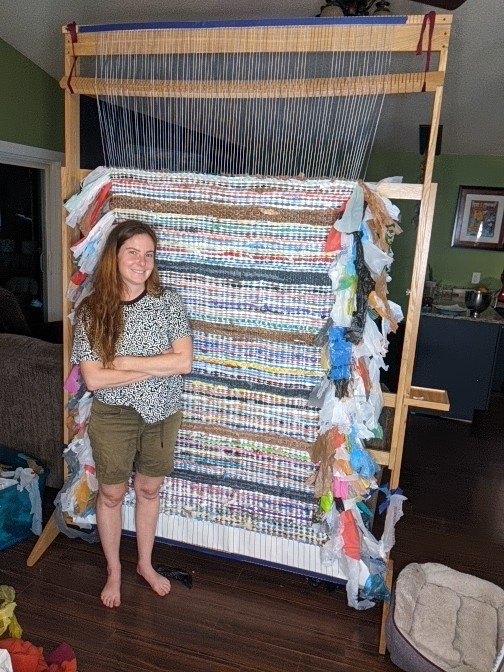
    Passionate about the intersection of people, animals, environment and activism, Kelsey Merreck Wagner is a Ph.D. candidate in the MSU Anthropology program and is also an artist. Since the pandemic, she has been weaving community trash into tapestries and preparing for her dissertation research trip to Thailand in October. 

    MSU Anthropology PhD candidate and local artist Kelsey Merreck Wagner stands with her tapestry she wove using plastic. For more of her art, visit her website. Photo credit: Kelsey Merreck Wagner. 

    “I was really drawn to the idea that weavings are inherently based in place because people generally use local fibers, whether it’s from sheep or local plant fibers, and the dyes from their materials come from their local ecosystems,” she said. “I really kind of wanted to do a satirical nod to that by thinking: Okay, what is my place-based weaving as a white woman in America? Plastic. Plastic. Plastic is my local resource that I have so much of. Trash is part of our environment and so plastic really can’t be separated from that. Because once it’s made, once it’s consumed and thrown away, it’s always going to be there. I started weaving with these as an experiment and realized I really loved the textures and patterns.”

    Once she began collecting trash from others, she realized how trash displays intersectional identities in a person or a community such as gender, age, race and class, almost like a portrait. 

    “I also see my art as a call out to these different brands and corporations as kind of an eye opener of how much plastic adds up over time,” she said. 

    Her work will be showcased in the upcoming MSU Museum Science Gallery 1.5 ° Celsius exhibition which begins on September 6, 2022, and will last through February 2023. The exhibition will include contributions of more than one dozen national and international artists, scientists, and researchers to help the public explore the global climate crisis. 

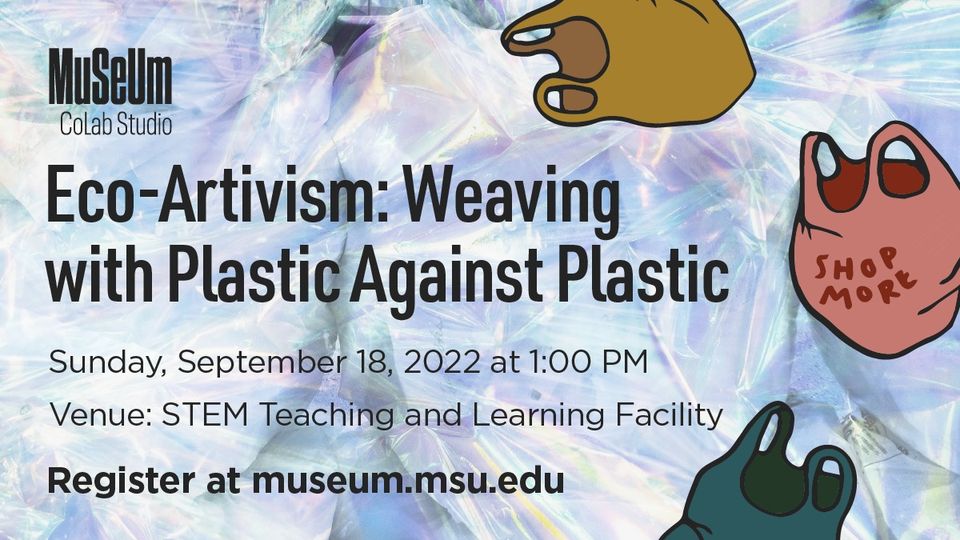
    “They also asked me to do a weaving workshop at the STEM building,” Wagner said. “I’m going to be bringing a huge, basic, wooden tapestry loom that I’ll build for this one project. I’ll be bringing in plastic and then workshop participants are also encouraged to bring in any kind of trash that they want to weave with. We’re going to all work together to do a collaborative community weaving and see what we can make. We will be able to think of it as a portrait of the community or of the participants thinking about all the different trash that we use.”

    Wagner will lead a weaving workshop on September 18 at the MSU Museum open to everyone in the community. Register at museum.msu.edu. Photo credit: MSU Museum. 

    Wagner’s undergrad training is in studio art and art history, and she found an interdisciplinary masters’ anthropology program where she was able to develop her art in relation to sustainability and the environment. 

    “I was passionate about and  wanted to get more involved with environmentalism, but I never saw myself as a  natural scientist,” she said. “But during my master’s, I started going to work at this elephant organization in Thailand, and it made me realize for the first time that conservation is really about people, and it’s about communities.”

    Once she graduated from her master’s program, she worked for a year in Cambodia for an environmental organization as their exhibitions coordinator for their natural history museum. She was applying to MSU at the time and getting in touch with Dr. Beth Drexler, who is now her current graduate advisor. 

    “She was excited about the idea of blending visual anthropology and interdisciplinary research, and environmental activism, which is so exciting, because it was important to me to find an advisor and a program that values interdisciplinary work and activism,” she said. “That’s really why I ended up at MSU in this program, because I felt like there’s so many people that were studying different things and blending different bodies of knowledge, especially in a four field program. And that felt like the right fit for me. It all fell into place that I would be able to use my background in arts, my love of elephants and the environment. And then just also being really interested in how people relate to environments.”

    Wagner is in her fourth year of her MSU Anthropology PhD program. In October, she will travel to Thailand to start her dissertation research. Her work focuses on human-environment and human-animal relationships, and how people have long-standing traditions of interacting with the environment, interacting with animals in the ecosystems in ways that are part of their culture. In Thailand, she is specifically interested in researching human-elephant relationships.

    “I have been obsessed with elephants since I was a little girl, so it’s been a life-long passion of mine,” Wagner smiled. “In Thailand, elephants are so common in material culture and pop culture. They’re the national cultural symbol, and everywhere you go, there are sculptures of elephants outside buildings, in restaurants, t-shirts, and tourism goods – you see elephants everywhere. I’m also an artist, so I like seeing how elephants are portrayed and what a particular culture or community within that culture thinks about these animals and how they treat them.”

    There’s a conservation component of her research where she’ll be continuing to work with the elephant organization Elephant Nature Park in Chiang Mai that she’s been working with since her master’s.

    “It’s a giant elephant sanctuary where they have over 100 rescued elephants that have been rescued from circuses, street begging, logging – many unethical, unfair labor situations. The sanctuary is run by a local Thai woman who only hires local Thai and nearby ethnic groups to work at this organization caring for the elephants. Then, tourists come in and pay to clean up after the elephants and feed them. It’s a huge organization that does a lot for local communities, including funding and building some local schools.”

    Wagner working with Elephant Nature Park in Chiang Mai, Thailand, where she will complete her dissertation research. Photo credit: Kelsey Merreck Wagner

    Through the organization, Wagner hopes to do a community engagement art project with the youth. While she envisions giant murals or a large art installation, she’s also leaving it open-ended because she wants the youth to express their ideas for the project.

    “I’m trying to really just make those connections between activism and expression, both personal expression and community expression by bringing in the idea of talking about the environment through art. Anthropologists are really interested in applied and activist anthropology, and pondering how our research can contribute to issues as broad as climate change and human rights. And so for me, that’s why it’s really important to be working on these different art projects and activism projects with community members, and especially youth, because I see it as my way to be able to like give back in this very specific art and activism skill set that I’ve been developing for more than 10 years now.” 

    View Wagner’s work and join in the discussion about climate change at the MSU Museum Science Gallery 1.5 ° Celsius exhibition: https://museum.msu.edu/?exhibition=1-5-celsius. The weaving workshop is on the MSU campus from 1:00-2:00 on Sunday, September 18. You can register here.

    To learn more about the MSU Department of Anthropology, visit anthropology.msu.edu

  • Dr. Barbara Rose Johnston, Adjunct Professor of Anthropology at Michigan State University, has been honored with a named award. At the annual American Anthropological Association (AAA) meeting this year the AAA Environment & Anthropology Society is launching the new award: Barbara Rose Johnston Travel Award.

    Barbara Rose Johnston Travel Award is a $1000 competitive grant to allow a society member at any stage in their career who lack institutional support to attend the AAA annual meeting and formally participate in Environment and Anthropology Society sessions. This competition is open to any member of the Society who lacks institutional support for conference travel, including those working for government agencies (federal, state, local, and tribal governments), nonprofits, community colleges, consultants, international scholars, and contingent faculty.

    Deadline to apply: October 3, 2022

    Full details can be found at:  https://ae.americananthro.org/prizes/barbara-rose-johnston-award/

  • Ph.D. Candidate Kiana Sakimehr wins the 2022 John F. Richards Fellowship offered by the American Institute of Afghanistan Studies (AIAS)

    The Department of Anthropology is pleased to announce that Ph.D. candidate Kiana Sakimehr has been awarded the John F. Richards Fellowship by the American Institute of Afghanistan Studies (AIAS). This institute is a private and non-profit organization located at Boston University and headed by scholars to promote and support the study of Afghanistan. 

    Kiana will use the funds to cover expenses related to her field research that focuses on Afghan refugees who recently arrived in the US. She intends to investigate the often-neglected emotional aspect of migration and how it shapes peoples’ interpretations and perceptions of their new reality as refugees. By focusing on the wide-ranging functions of emotions, her project examines the possible reconfiguration of and transitions in emotions with regards to expectations of living in the US. Moreover, her study explores the role of institutional structural possibilities and constraints regarding these transitions in emotions. Kiana acknowledges the support she has received from her committee members, specifically her advisor Dr. Chantal Tetreault.

  • Associate Professor Dr. Masako Fujita publishes in the American Journal of Biological Anthropology

    Department of Anthropology Associate Professor Dr. Masako Fujita and co-authors Katherine Wander, Tin Tran, and Eleanor Brindle recently published an article in the American Journal of Biological Anthropology. The article is titled “Characterizing the extent human milk folate is buffered against maternal malnutrition and infection in drought-stricken northern Kenya.” This publication investigates whether and how the extent of maternal buffering of milk folate may diminish under prolonged nutritional and disease stress, while taking into consideration infants’ varying vulnerability to malnutrition-related morbidity/mortality. The results of this study suggest that mothers buffer milk folate against their own nutritional stress even during a prolonged drought; however, the extent of this buffering may vary with infant age, and, among folate-deficient mothers, with infant sex.

    Read the full article at: https://doi.org/10.1002/ajpa.24603

    Abstract:

    Objectives: Folate is an essential nutrient fundamental to human growth and development. Human milk maintains high folate content across the maternal folate status range, suggesting buffering of milk folate with prioritized delivery to milk at the expense of maternal depletion. We investigated whether and how the extent of this buffering may diminish under prolonged nutritional and/or disease stress, while taking into consideration infants’ varying vulnerability to malnutrition-related morbidity/mortality.

    Methods: A cross-sectional study analyzed milk specimens from northern Kenyan mothers (n=203), surveyed during a historic drought and ensuing food shortage. Multiple regression models for folate receptor-α(FOLR1) in milk were constructed. Predictors included maternal underweight (BMI < 18.5), iron-deficiency anemia (hemoglobin <12 g/dl and dried-blood-spot transferrin receptor >5 mg/L), folate deficiency (hyperhomocysteinemia, homocysteine >12 or 14μmol/L), inflammation (serum C-reactive protein >5 mg/L), infant age and sex, and mother-infant interactions.

    Results: In adjusted models, milk FOLR1 was unassociated with maternal under-weight, iron-deficiency anemia and inflammation. FOLR1 was positively associated with maternal folate deficiency, and inversely associated with infant age. There was interaction between infant age and maternal underweight, and between infant sex and maternal folate deficiency, predicting complex changes in FOLR1.

    Conclusions: Our results suggest that mothers buffer milk folate against their own nutritional stress even during a prolonged drought; however, the extent of this buffering may vary with infant age, and, among folate-deficient mothers, with infant sex. Future research is needed to better understand this variability in maternal buffering of milk folate and how it relates to folate status in nursing infants.

  • Associate Professor Dr. Elizabeth Drexler publishes in Oxford University Press’ International Journal of Transitional Justice

    Department of Anthropology Associate Professor Dr. Elizabeth Drexler publishes in the International Journal of Transitional Justice. The article, titled, “Impunity and Transitional Justice in Indonesia: Aksi Kamisan’s Circular Time” argues the Indonesian weekly Thursday silent protests by victims’ families, create sites of justice bringing together technical legal demands with compelling artistic performance to highlight the problem of persistent but invisible impunity, counter the legacies of authoritarian era social stigmatization, and expose the problematic nature of temporality in conventional transitional justice mechanisms.    

    Read the full article at: https://doi.org/10.1093/ijtj/ijac010

    Abstract: This article positions the Indonesian weekly Thursday silent protests by victims’ families, Aksi Kamisan, as a space of and beyond transitional justice. Analysing Kamisan as repeated, embodied creative acts that reset perceptions, possibilities and imaginations about social belonging, political subjectivity and national identity discloses how authoritarian era affective forces undermine transitional justice and demonstrates the power of alternative temporalities in coming to terms with past violence. ‘Circular time’ brings past and present injustice into the same frame as consistent action extending into the future. Circular time highlights how the time of waiting, uncertainty and lack of justice extends backward and forward connecting past, present and future in the repetition of impunity, and creates community and the space to imagine just futures. Circular time is created by repeated action against impunity in the present and celebrating the perseverance, consistency and agency of victims. Circular time resists the imposition of temporal linearity. Art performed at Kamisan and the act of standing in solidarity engages communities and audiences in a realm of politics and national belonging that is not possible in formal institutions. Over time, these repeated, temporary, inclusive actions can counter still resonant authoritarian era propaganda.