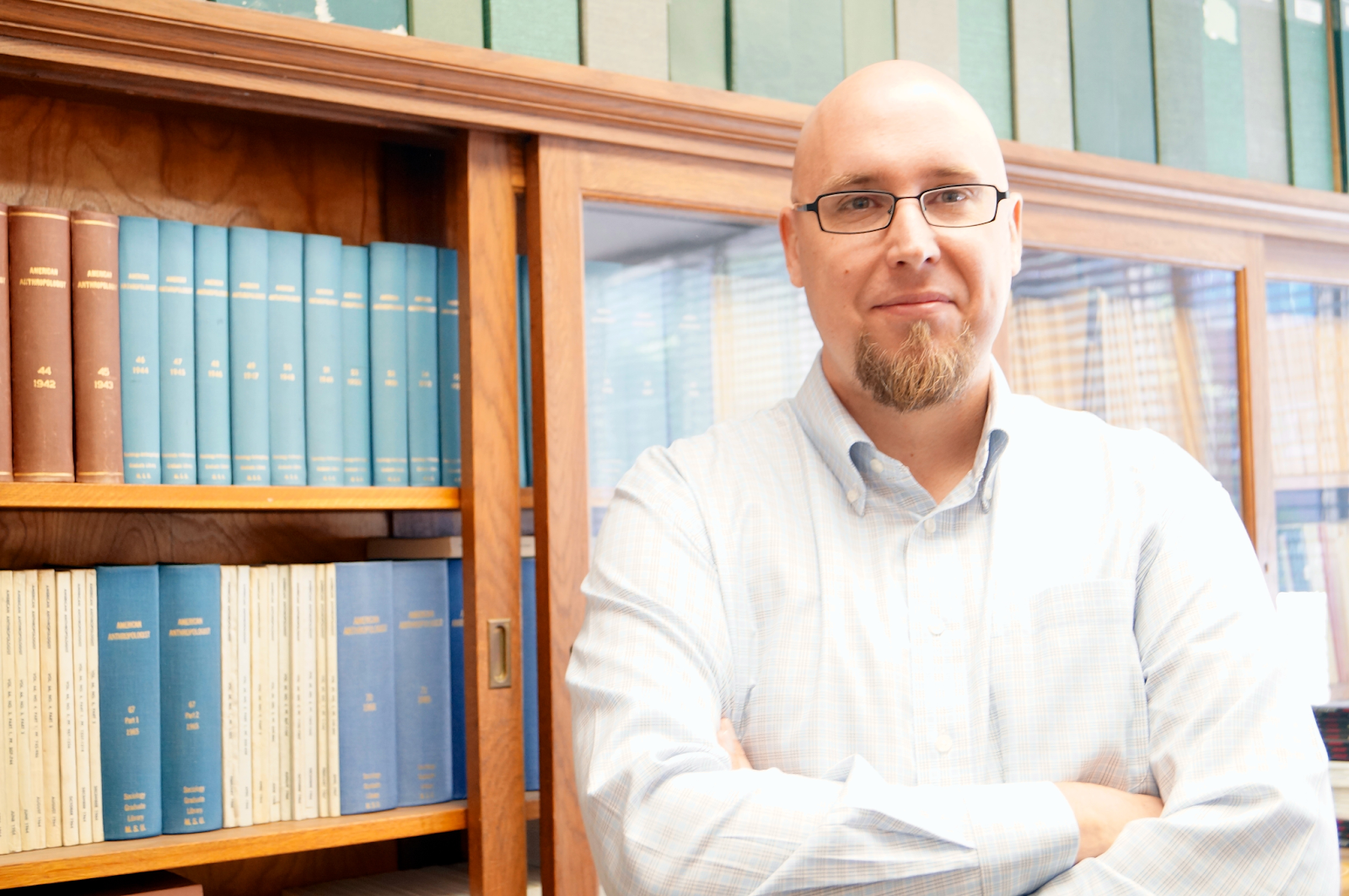
Associate Professor of Anthropology Dr. Masako Fujita recently coauthored Does the immune system of milk increase activity for infants experiencing infectious disease episodes in Kilimanjaro, Tanzania? which appears in the American Journal of Human Biology.
The Department of Anthropology is pleased to announce that Professor Emeritus Dr. William Lovis has been recognized as a fellow of the American Association for the Advancement of Science, or AAAS.
Dr. Lovis was recognized as a fellow of the AAAS earlier this year, along with four other Michigan State University researchers.
Lovis was selected as an AAAS fellow for his significant contributions to archaeological research, collections stewardship, and student and public education.
Lovis said the recognition has significant meaning because he has been a member of the AAAS since graduate school, which was more than 50 years ago.
“First of all, it’s really very pleasing to be recognized by my colleagues and peers for what I’ve achieved in my career,” Lovis said. “I have a lot of gratitude for having been conferred that honor . . . “
In addition to Lovis’ recognition as a fellow, he was also selected to serve on the Steering Committee for the Anthropology Section (H) of the AAAS.
Given his record of leadership, experience, and expertise in the management of professional organizations, Dr. Lovis will collaborate with other Steering Committee members in the multi-year Anthropology Section transition to a new organization-wide AAAS Governance Modernization Project.
In fact, part of Lovis’ role on the Steering Committee is to select AAAS fellows for next year, a challenge to which he is looking forward.
“Not having been through the process at the other end, this is going to be a learning year for me, too,” Lovis said. “But part of it is knowing who among my colleagues is doing useful, recognized work that other people are using and where they’re making an impact on the discipline in a visible way.”
Dr. Lovis is pleased about his selection and looks forward to the exciting opportunity of moving anthropology forward in one of the nation’s oldest national scientific societies.
“A lot of what I’ve done professionally is very much aligned with many of the goals of the AAAS, and I think that was part of why I was recognized; there is a pretty tight alignment there,” Lovis said.
“Then the other part of it is that I’ve worked diligently in an interdisciplinary fashion to insert more natural and biological science into the kind of archaeology that we’re doing.”
Lovis said given today’s need for scientific experts to fight the “war on science,” he is happy to offer his time and experience to something in which he believes.
“The scientific basis for knowledge is under a fair amount of stress at this point, and I think it’s essential that we don’t let that continue,” Lovis said.
“This is an opportunity to assist in working effectively to bring to the public the notion that science is actually useful, and something that can benefit their lives, rather than something that you undermine and see as more of an ideological problem. Providing a better understanding of science to the public will assist in moving us in this more positive direction.”
The Department of Anthropology encourages all archeology students to apply for The Alumni & Friends Fund for Archeology. This fund is intended to support MSU Department of Anthropology archaeology students who have demonstrated the capacity to achieve educational and professional goals, the motivation to achieve these goals, and the initiative to seek opportunities to further their progress. The fund, which is open to both graduates and undergraduates, may be used to support a variety of activities or needs, including professional development, travel, research, fieldwork, and equipment.
The Department of Anthropology encourages all graduate students to apply for The William A. Lovis Research Fund in Environmental Archaeology. This fund is intended to support interdisciplinary environmental archaeological research bridging anthropological archaeology and the natural, physical, biological and earth sciences. It is designed to underwrite and enhance the work of graduate students who investigate human/environment interaction for deeper time periods prior to Euro-American colonization episodes worldwide.
How to apply: Application should be made via letter (no more than two pages in PDF format) addressed to the Archaeology Faculty and must be sent to Cathi Pierce (piercec7@msu.edu) by the listed deadline with the name of the fund as the subject heading. Applicants should provide an overview of their progress in their program of study and eligibility, description of their research or other eligible activity, and a specific discussion about their anticipated use of the funding. Any applicant who previously received any department archaeology award (William A. Lovis Research Fund in Environmental Archaeology, Alumni and Friends Fund for Archaeology, or Lynne Goldstein Fellowship) must also include a separate written summary of no more than one page providing details on what was done with the previous award(s), how this new application is distinct from previously funded work, and how the new proposed work articulates with previously funded work (if relevant).
In addition to the letter of application, a detailed budget and budget justification (no more than two pages in PDF format) must be included in the application material. All applicants should have their advisor’s approval for the application and proposed activity.
Eligibility: Applicant must be a graduate student enrolled in anthropological archaeology within The Department of Anthropology, specializing in interdisciplinary environmental research and in good standing with MSU.
Funding: The total amount of funding available this year will be $1500
The Lynne Goldstein Fellowship Fund is open to graduate students enrolled in the MSU Department of Anthropology, with preference given to those students who have participated in the Campus Archaeology Program. Funds are intended to assist students doing their dissertation research, which does not need to be linked to Campus Archaeology.
How to apply: Application should be made via letter (no more than two pages in PDF format) addressed to the Archaeology Faculty and must be sent to Cathi Pierce (piercec7@msu.edu) by the listed deadline with the name of the fund as the subject heading. Applicants should provide an overview of their progress in their program of study, description of their research, and a discussion of how the funds will support their ongoing dissertation work. Any applicant who previously received any department archaeology award (William A. Lovis Research Fund in Environmental Archaeology, Alumni and Friends Fund for Archaeology, or Lynne Goldstein Fellowship) must also include a separate written summary of no more than one page providing details on what was done with the previous award(s), how this new application is distinct from previously funded work, and how the new proposed work articulates with previously funded work (if relevant).
In addition to the letter of application, a detailed budget and budget justification (no more than two pages in PDF format) must be included in the application material. The committee requires that the applicant’s dissertation advisor send a statement of endorsement for the application via email to Cathi Pierce (piercec7@msu.edu). Experience (if any) in the Campus Archaeology Program should be indicated in the application letter.
Eligibility: Open to both graduates and undergraduates and is intended to support the research, scholarly activities, and professional development of MSU Department of Anthropology archaeology students.
Funding: The total amount of funding available this year will be $1500
The Altimare Professional Development Scholarship is intended to support graduate students enrolled in the MSU Department of Anthropology to gain practical skills, training, certification, professional development and/or qualitative data software experience, contributing to tangible and recognized competencies by future employers and aid the student in being a competitive applicant for non-academic jobs post-graduation. Examples include: conference training (tutorials/workshops) to learn new skills, techniques or specialties; online certifications, (LinkedIn Learning, Udemy, Coursera) on project management, UX Design, video production; purchase of qualitative data analysis software (MAXQDA, NVivo, Atlas.ti), etc. Please note that a total of $1,000 is available this year. This amount can be divided and distributed to one or more students.
How to apply: Application is made via letter (1-2 pages) addressed to the Altimare Scholarship Committee. Applicants should provide an overview of their progress in the program of study, and how the scholarship will be used to benefit their progress. The committee requires that the dissertation advisor send a statement of endorsement for the application via email. Letter of application and endorsement should be submitted via email to Cathi Pierce at piercec7@msu.edu with Altimare Scholarship in the subject line of the email.
The Whiteford Cultural Anthropology Field Work Scholarship is awarded to cultural anthropology graduate students in the MSU Department of Anthropology with preference given to students conducting research in Latin America. This $2,000 award is intended to assist students doing their dissertation field work by helping cover key associated costs, such as transportation and lodging. Eligibility: Must be a graduate student in cultural anthropology enrolled in the MSU Department of Anthropology.
How to apply: Application is made via letter (1-2 pages) addressed to the Whiteford Scholarship Committee. Applicants should provide an overview of their progress in the program of study, a description and timeline of their dissertation research, and how the scholarship will benefit that research. The committee requires that the dissertation advisor send a statement of endorsement for the application via email. Letter of application and endorsement should be submitted via email to Cathi Pierce at piercec7@msu.edu with Whiteford Scholarship in the subject line of the email.
Join the Anthropology Department for a lecture series, this time with Dr. Eric J. Montgomery! Montgomery will host the lecture “Spirits, Ancestors, and Taboo: Divination as Ethnographic Method” on March 13 from 3:30 P.M. – 4:30 P.M. in McDonel Hall C103.
Divination has long fascinated ethnographers, and the amount of case studies throughout the world proliferate in the academic literature. Like “witchcraft” and “sorcery” these indigenous thought and belief systems are often mystified inside and outside of academia. Many view divination and related concepts as “tradition,” “custom,” and “historical survivals,” however, they are actually innovative, adaptive, and also growing in importance in places like Western Africa, Latin America, and The Caribbean. This lecture will take a comparative approach to various ethnographic examples of divination from Western Africa (Ifa/Fa/Afa) and Oceania writ large and assess their importance for decolonizing anthropology today.
The Society of Antiquaries elected Dr. Ethan Watrall, associate professor in the Michigan State University Department of Anthropology, as a fellow. The Society of Antiquaries was founded in 1707, and represents the oldest learned and prominent scholarly society focusing on heritage and archaeology. The society’s 3,000 elected members include some of the most prominent scholars and professionals in heritage and archaeology such as national museum directors, curators, directors of heritage preservation trusts and non-profits, and members of the UK parliament. Dr. Watrall is the first MSU professor to have ever been granted this distinction, only the fourth elected from the Big 10, and the ninth from the United States.
“Being named a Fellow of the Society of Antiquaries is enormously important to me as it is a recognition of the importance of my work to the fields of heritage and archaeology,” Dr. Ethan Watrall said. “It also reflects very well on the Department of Anthropology by shining a spotlight on the outstanding research, teaching, and outreach we’re doing in heritage, preservation and community engagement.”
Dr. Watrall was elected due to the notoriety of his research, teaching and outreach in the use of digital methods and computational approaches to document, preserve, contextualize, and provide access to tangible heritage and archaeology.
“I strive to leverage digital methods to preserve and provide access to archaeological and heritage materials, collections, knowledge, and data in order to facilitate research, advance knowledge, fuel interpretation, and democratize understanding and appreciation of the past.”
In most cases, his research leans towards providing a mechanism for the public to engage with and understand our collective heritage.
“But it’s not just about public access to digitized heritage,” he explained. “My work also focuses on collaborating with communities to digitize their own heritage and tell their own stories about their past with that digitized heritage. A lot of my work also intersects with museums and other collections holding heritage institutions, building workflows and platforms to digitize, provide access to, and contextualize natural and cultural collections that are often completely inaccessible to the public, communities, students, and scholars.”
While Dr. Watrall has directed or co-directed many externally funded digital heritage and archaeology projects, a recent example of his work in this area is the Internment Archaeology Digital Archive (IADA), which he co-directs with his Department of Anthropology colleague Dr. Stacey Camp. Currently funded by the National Park Service and developed in collaboration with MSU’s Matrix: The Center for Digital Humanities and Social Sciences, IADA is an open digital archive that will host, preserve, and provide broad public access to digitized collections of archaeological materials, archival documents, oral histories and memorabilia that speak to the experiences of Japanese Americans incarcerated during World War II in the United States.
“A significant amount of the digitization work on this project is happening in my lab at MSU (Digital Heritage Innovation Lab), including using various techniques to create 3D scans of artifacts and objects from two sites of internment and incarceration – the Minidoka National Historic Site (the site of Minidoka War Relocation Center) and the Kooskia Internment Camp While IADA is primarily designed to address the immediate needs of Kooskia and Minidoka’s descent communities, Japanese Americans, and scholars of Asian American studies and incarceration, the project’s audience extends well beyond these groups. In its broadest, IADA provides testimony and material evidence of the trauma wrought by incarceration and discrimination.”
Additionally, the focus of Dr. Watrall’s teaching helps to prepare future generations of Anthropologists to engage in digital methods and computational approaches to preserve heritage. He regularly teaches ANP 412: Methods and Practice in Digital Heritage and ANP 465: Field Methods in Digital Heritage – the only class of its kind in the U.S.
“Beyond my curricular efforts, I also direct the Cultural Heritage Informatics Initiative, which provides graduate students interested in cultural heritage with the space to learn how to apply digital methods and computational approaches to their work,” he said.
All new fellows are formally admitted to the society during a ceremony at Burlington House, the society’s headquarters in London, where they sign the register of admissions and are welcomed into the society. Dr. Watrall hopes to attend the ceremony the next time he’s in London.
“It is my hope that the being named a fellow will help greatly increase the number of graduate students wanting to come to MSU to work with me and my colleagues in the department, provide more opportunities to secure external funding to support our work, provide more opportunities for innovative collaboration with other scholars and units around campus, and encourage the college and university to invest more resources in our work and allow us to grow and extend our reach and impact.”
To learn more about the MSU Department of Anthropology, visit anthropology.msu.edu.
Alumna Assistant Professor Dr. Susan Kooiman (SIU- Edwardsville), Professor Emerita Dr. Lynne Goldstein, Professor Emeritus Dr. William Lovis and MSU Geography Professor Dr. Alan Arbogast publish in Midcontinental Journal of Archaeology. This collaborative paper, titled, “The Precontact Archaeology of the Michigan State University Campus and the Campus Archaeology Program (CAP)”, presents the origins and role of the MSU CAP, and in doing so frames the diverse knowledge bases and intellectual partnerships through which the indigenous pre-EuroAmerican occupation of what is now the MSU campus is currently known. Drawing on oral accounts, MSU Museum collections, CAP excavations, and linkages with the landscape evolution of the campus, this comprehensive effort documents Indigenous use of the banks of the Red Cedar River at MSU for over 3000 years. It not only provides a substantial foundation for future campus research, but also presents important insights into the deep Native American heritage of lands now occupied by MSU.
Abstract: Here we summarize the current state of knowledge about the precontact archaeology of the Michigan State University (MSU) campus as revealed through work conducted by the MSU Campus Archaeology Program (CAP), the MSU Museum, and the Department of Anthropology. A multipronged approach places this collective work in programmatic, institutional, historical, geographic, and archaeological context. The history of CAP and its impact on campus operations and understandings of campus history demonstrate the strength of such programs. Unpacking the MSU Museum collections reveals additional insight into the deep Indigenous history of university lands. Results of the first systematic excavations of a precontact Archaic site on the MSU campus, the Beaumont West site (20IN205), are reported alongside accounts of systematic archaeological survey conducted over a span of 70 years, recent geomorphological work, and the cumulative collections of precontact material culture from the MSU campus housed at the MSU Museum. Collectively, this paints an engaging multifaceted story of an ever-changing natural and social landscape that highlights the value of understanding the role college campuses can play in providing information about the distant as well as the recent past.