• MSU unearths observatory foundation more than a century old

    MSU unearths observatory foundation more than a century old

    Discovery gives insight into campus history, provides educational opportunities

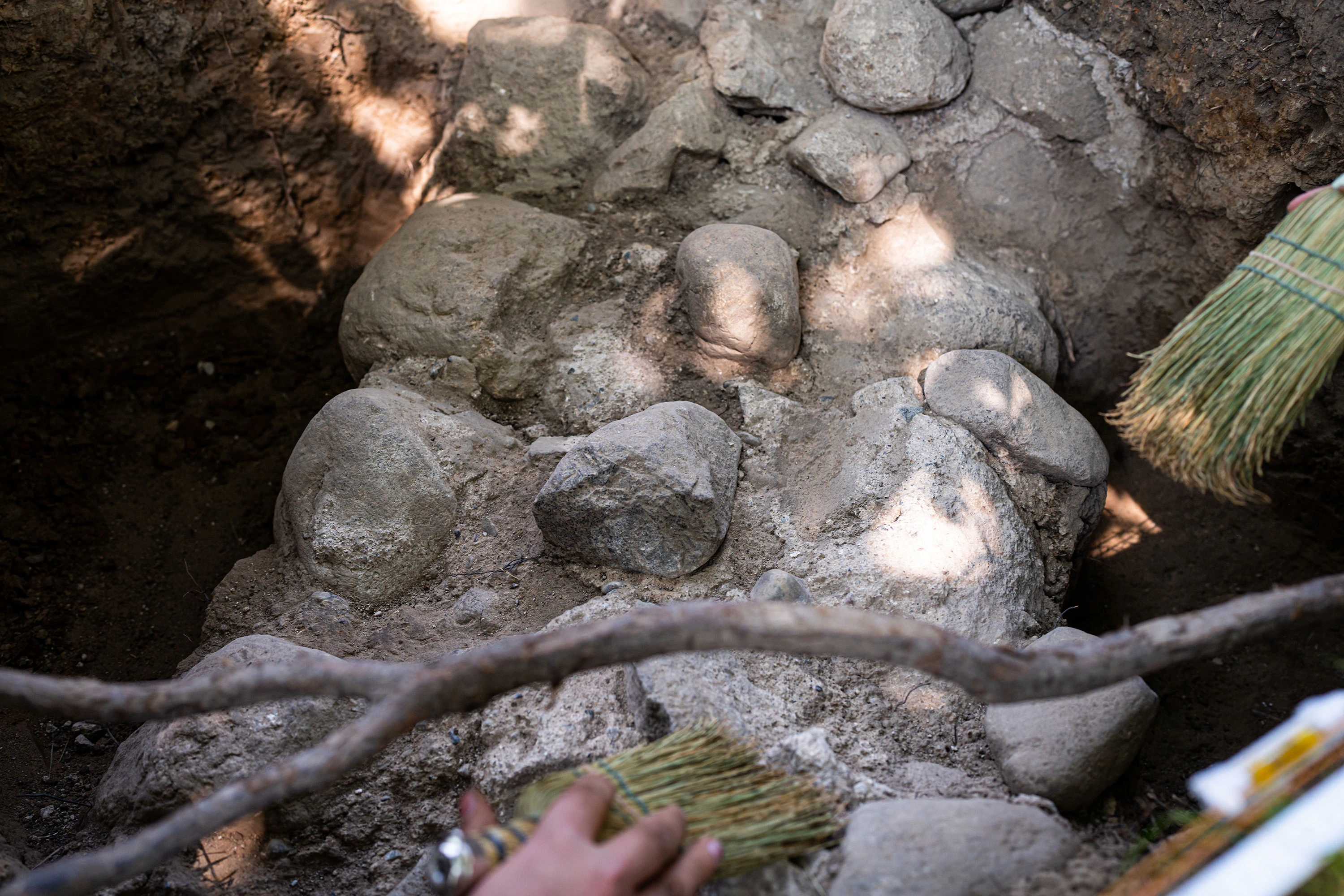
    In summer of 2023, workers from Michigan State University Infrastructure Planning and Facilities, or IPF, were installing hammock posts close to student residence halls near West Circle Drive when they encountered a hard, impenetrable surface under the ground. 

    Believing it to be either a large rock or building foundation, IPF called MSU’s Campus Archaeology Program, or CAP. After cross-checking old maps, campus archaeologists determined that it was the foundation of the first observatory on MSU’s campus, constructed in 1881. 

    “The campus archaeology program is designed to protect and mitigate our below ground heritage here at MSU,” said Stacey Camp, director of CAP and associate professor of anthropology at MSU, “We collaborate with IPF on construction projects and we are involved in preplanning stages to ensure that if they potentially hit an archaeological site, we can protect it in some manner.”

    The observatory discovery gives insight into how scientific observation, as well as life on campus, has changed over the last 140-plus years.

    “It gives us a sense of what early campus looked like in the late 19th century,” said Ben Akey, MSU campus archaeologist and anthropology doctoral student. “The original campus observatory was built and used at a time when Michigan Agricultural College — what would become MSU — was a radically different institution with only a handful of professors and a relatively small student body.”

    Akey’s role entails collaborating with IPF to keep up with campus construction projects, researching any discoveries and supervising crews of students participating in on-campus archaeological dig sites. Working closely with MSU Archives, Akey conducted most of the research to confirm that IPF’s discovery was indeed the foundation of the first campus observatory. They also drew on the book “Stars Over the Red Cedar” by Horace A. Smith, professor emeritus in the MSU Department of Physics and Astronomy for additional information.

    “I did a lot of reading to learn more about the first observatory: its history, how it was used and what the building itself might have looked like,” Akey said.

    Astronomical observation at MSU: Then and now

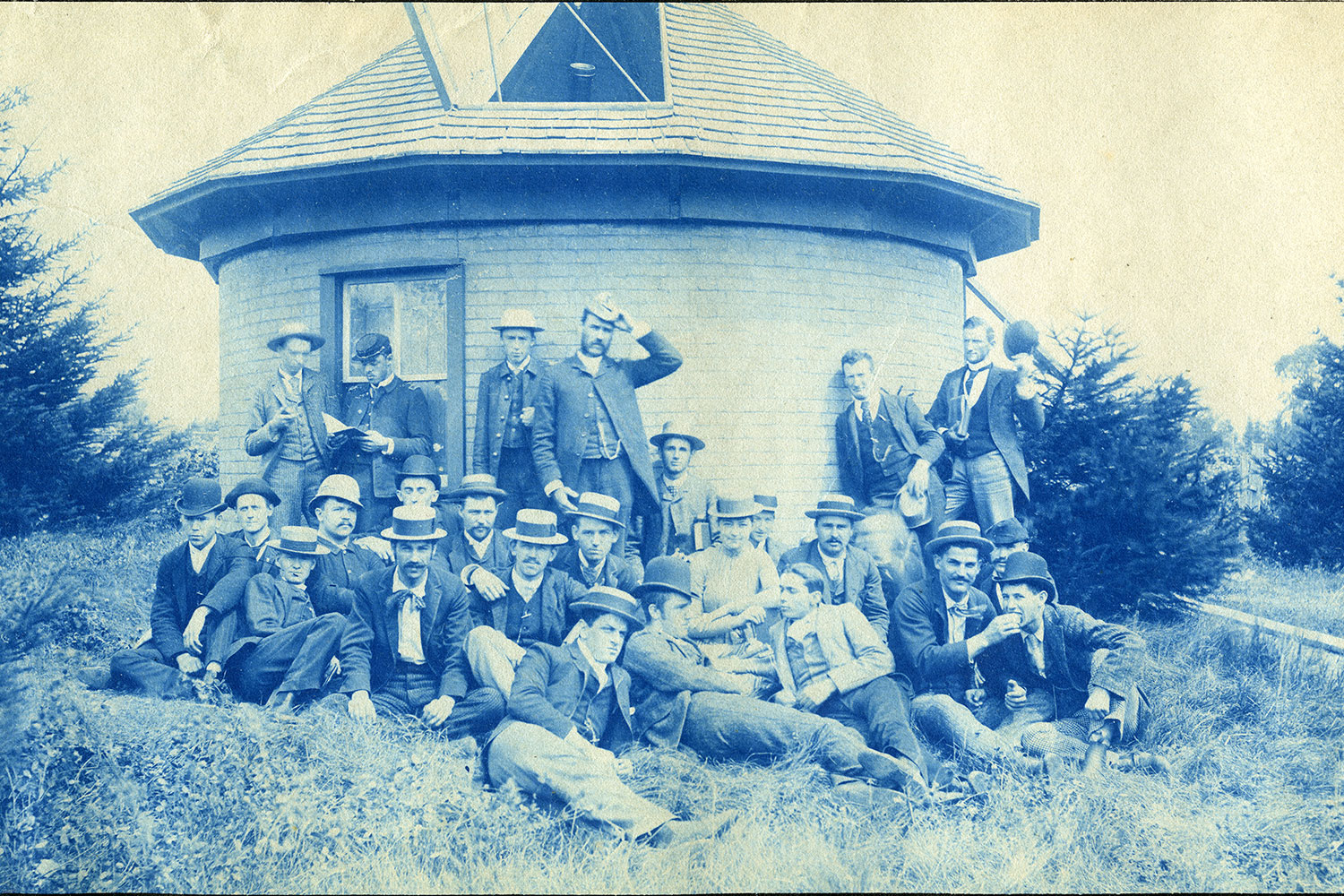
    Located just behind what is now Wills House, the first observatory on MSU’s campus was built by Professor Rolla Carpenter. An 1873 graduate of Michigan State Agricultural College, Carpenter returned as a professor and taught a wide variety of courses, including mathematics, astronomy, French and civil engineering. 

    “In the early days of MSU’s astronomy program, Carpenter would take students to the roof of College Hall and have them observe from there, but he didn’t find it a sufficient solution for getting students experience in astronomical observation,” Akey said. “When MSU acquired a telescope, Carpenter successfully argued for funding for a place to mount it: the first campus observatory.”

    Individuals pose outside of MSU’s first observatory, circa 1888. The observatory is located behind where Willis House now stands on MSU’s campus, just south of Grand River in North Neighborhood. Photo courtesy of Michigan State University Archives and Historical Collections.

    Today, the MSU observatory is located just south of campus at the intersection of Forest and College roads. It boasts a 24-inch telescope and is used for undergraduate and graduate education and research, as well as faculty research. It also hosts free public observation nights.

    Levi Webb is a fourth-year astrophysics and anthropology major who works at MSU’s current campus observatory and participated in the archaeological dig of the first on-campus observatory. 

    “It’s amazing to see how far we’ve come from a little 16-foot circular building to a large building with a high-quality telescope and an electric dome,” Webb said. “Seeing the difference between how observing used to be versus how it is now is very interesting to me and makes me appreciative of the observatory we have now.”

    Real-world experience: Field school and summer digs

    While most students who work with campus archaeology are anthropology majors, some — like Webb — have backgrounds in other areas of study. In addition to Webb, the observatory dig crew included students majoring in classical and romance studies and forensics. 

    “Having students from majors outside anthropology gives us a different perspective on what we’re finding in the ground,” said Camp. “We feel really lucky to have a wide variety of knowledge on our dig sites.” 

    Akey said working on a dig site, such as the first campus observatory, helps prepare students for careers in archaeology. 

    “CAP provides an essential venue of professional training for both graduate students and undergraduates in archaeological fieldwork in analysis,” Akey said.

    One training opportunity is an undergraduate field school led by CAP. Most archaeology and anthropology programs require fieldwork, which is often done overseas and can often be costly. Every other summer, MSU hosts a field school that gives Michigan students who are interested in archaeology, but may not have the financial resources to travel abroad, an opportunity to do hands-on work on an actual site. 

    For the upcoming field school in 2024, CAP is planning to focus on the first observatory site.

    “Next summer, we’re planning to run an undergraduate archaeological field school where students can enroll for credit and get experience excavating the foundation of the first observatory on campus,” Camp said. “We anticipate having 18 to 20 students work on the project and get great experience doing archaeology.”

    Camp said seeing students develop an interest in connecting the past with the present energizes her.

    “I love watching students connect with artifacts and try to tell a bigger story about humankind with those objects,” she said. 

    Connecting past and present

    Akey said they appreciate the unique opportunity to learn more about MSU’s campus history while developing skills that will serve them beyond the completion of their Ph.D.

    “One of the things I value most about archaeological work is kind of building a sense of connection to landscapes and people,” they said. “With a campus this old, there’s a lot of historic materials, archaeological materials that would be disturbed by all the ongoing construction on campus. Because of our partnership with IPF, those objects are not disturbed, and we get a chance to document and analyze some of them. It’s a pretty cool job.”

    Camp was initially drawn to archaeology as a tactile way to interact with history and gain new perspectives.

    “Archaeology gives us a bit more knowledge about how people lived in the past, how they did things differently and how maybe we could do things differently in the contemporary world as well,” she said. 

    Webb sees this firsthand through his work at the observatory and on archaeological dig sites. 

    “In my job working outreach at the observatory, I meet people who graduated from MSU many, many years ago who come and see the work that we’re doing, and they’re very proud to see how campus has grown,” he said. “I have even more insight into the campus’ evolution after learning about the first observatory and the history of scientific observation on campus.”

    Camp said she feels honored to connect MSU’s past to its present through her work with CAP.

    “MSU is a passionate and dedicated community,” she said. “Spartans are very invested in this campus and its history, and being able to share a little bit of my knowledge with people is very rewarding.”

    View more images from the dig site here.

    Media Contact: Alex Tekip

  • Melanie Pitt named Outstanding Senior 

    Melanie Pitt named Outstanding Senior 

    Graduating Senior Melanie Pitt of Farmington Hills, Mich. has been chosen by the Department of Anthropology as this year’s Outstanding Senior. 

    Pitt said she was elated and shocked when she heard the news.  

    “It was very unexpected,” Pitt said. “I don’t tend to expect much from what I have done, but it was a nice surprise. I was really happy.”  

    Professor of Anthropology and director of the MSU Bioarcheology Laboratory Dr. Gabriel Wrobel nominated Pitt for the award because she showed initiative with organization, something that is crucial for work in the lab. 

    Wrobel said Pitt’s organization set her apart from other students.  

    “When I first met Melanie and I talked to her a little bit, I immediately saw that she just had an organized brain and she liked to put things in order. And I thought, I need somebody that can do that in this lab,” Wrobel said.  

    “She was clearly prepared and organized and that was great,” Wrobel added. “I love finding students like that.”  

    Pitt transferred to MSU from Schoolcraft College in Livonia in 2021. She previously studied at Albion College, where she worked as a research assistant in the Anthropology Department. Pitt said she always enjoyed studying anthropology and the thought of studying and working in MSU’s bioarcheological lab intrigued her.  

    “When I was transferring into a bigger university, I started to think, ‘Oh, maybe forensics would be interesting,” she said.  

    Pitt said she did more research and connected with Professor of Anthropology Dr. Stacey Camp, who helped her narrow down which subfield she wanted to study: bioarcheology. 
     

    Wrobel helped Pitt secure the Dean’s Assistantship grant through the College of Social Science. The grant, a $5600 stipend, gives students “the opportunity to have an enriched independent research experience in the social sciences with a faculty mentor.”   

    Pitt worked closely with Dr. Wrobel to create a digital repository for the bioarcheology lab using Kora.  

    Kora is an open-source, database-driven, online digital repository application for complex multimedia objects (text, images, audio, video) created by MATRIX. The application ingests, manages, and delivers digital objects with corresponding metadata that enhances the research and educational value of the objects. (from Kora’s website).  

    “She has completely restructured the lab and how we organize the materials that are in it, how we find things, how we keep digital records,” Wrobel said. “It has been a huge help.”  
     

    Pitt said organization did not always come naturally to her, but following her diagnosis of attention deficit disorder, things got easier, and she started to excel in her college courses.  

    “I’d always sort of thought I was just a bad student, my peers never seemed to struggle with homework and studying the way I did,” Pitt said. “Once I was diagnosed with ADHD and began treating it, the difference was unbelievable – it was like I had needed glasses my whole life and never understood why I could not read the board like everyone else. I was not a bad student, my brain just worked differently, and I had never had the means to excel.”  

    “Before coming to MSU, I didn’t know what I wanted to do after college,” Pitt said. “I’m still a little unsure, I am figuring it out as I go. I love archaeology, and this experience with the digital archive and organizing the lab has shown me I also really like collections management. It has given me a few things to think about as potentials for future careers.”  

    After graduation, Pitt is slated to join Dr. Wrobel in Belize where they and other members of the Ambergris Caye Archaeological Project, including Maya students from Belize, will excavate an ancient Maya site community. Pitt will lead the project’s field lab. 

    Pitt said she is excited about the opportunity to travel, and she is looking forward to continuing her work. She said it is bittersweet to look back on her college career and she is proud of how far she has come.  

    “It’s strange to look back six years ago and remember how much harder school used to be for me,” Pitt said. “At the same time, I would not have it any other way. I think the way that I was when I first started college and the struggles that I faced were essential for where I am now. That was a foundation that I needed to build upon. But it was all necessary steps to get to where I am now.”  

  • Associate Professor Dr. Elizabeth Drexler publishes in Visual Anthropology Review

    Associate Professor Dr. Elizabeth Drexler publishes in Visual Anthropology Review

    Department of Anthropology Associate Professor and Director of Peace and Justice Studies Dr. Elizabeth Drexler published an article in Visual Anthropology Review. The article is titled, Seeing Gaslighting: Photo-Dialogues and Structural Injustice. Focusing on gaslighting, the article reveals a process that manipulates perception to obscure systemic inequality and injustice and produce complacency and/or inability to perceive complicity in an unjust system through photo-dialogs that engage the sensory and affective rather than evidentiary aspect of images of injustice. 

    This article is based on a project supported by the Provost Undergraduate Research Initiative Award (2019-20 and 2020-21) that generously funded Isabel Hersey’s research assistance. 

    White Girl Tears Have Power
     Source: Lillian Young.

    Read the full article at: https://doi.org/10.1111/var.12286

    Abstract: Extending photovoice methodology, I describe a process of seeing structural injustice through photo-dialogues.   In a collective context where state and society collude in normalizing and extending injustice through both law and systemic gaslighting, the problem of exposing injustice with images involves issues of common sense, language, institutions, and access to various forms of power. “Seeing gaslighting” reveals a process that manipulates perception to obscure systemic inequality and injustice and produce complacency and/or inability to perceive complicity in an unjust system. Photo-dialogues engage the sensory and affective rather than evidentiary aspect of images of injustice.

  • Associate Professor of Anthropology Dr. Heather Howard co-publishes chapter in Michigan Salvage: Bonnie Jo Campbell and the American Midwest

    Associate Professor of Anthropology Dr. Heather Howard co-publishes chapter in Michigan Salvage: Bonnie Jo Campbell and the American Midwest

    Associate Professor of Anthropology Dr. Heather Howard co-published a chapter in Michigan Salvage: Bonnie Jo Campbell and the American Midwest. “Indigeneity in Once Upon a River” and accompanying teaching activity, “What’s your Indigenous narrative?”

    In this chapter, Howard-Bobiwash examines transformations in the tropes of indigeneity in Bonnie Jo Campbell’s Once Upon a River (2011), from novel to the feature film version of the book released in 2019. The role of fiction in the production of knowledge about Indigenous peoples is explored through questions of representational practice, and intersections of race, gender, identity, and landscape. The accompanying teaching activity prompts students to think critically about how portrayals and silenced absences of Indigeneity all around us are and produce social norms with real consequences for Indigenous persons and communities.  

    Michigan Salvage is the first scholarly collection on celebrated writer Bonnie Jo Campbell, the author of two novels and three short story collections, including National Book Award finalist American Salvage (2009). Her writing captures a diverse and bustling rural America, brimming with complex characters who struggle with addiction, poverty, and land degradation—issues that have become, undeniably, part of the southwestern Michigan landscape that she calls home. The essays in this volume demonstrate many rich ways to approach Campbell’s writing, from historical and cultural overviews to essays examining the class and gender implications of her stories and novels, to teaching essays highlighting how to use her work in the classroom and beyond. Along with each essay, Michigan Salvage also features lesson plans and writing prompts meant to spark discussion and encourage further investigation into these stories and novels.

    Howard-Bobiwash, Heather A. (2023). “Indigeneity in Once Upon a River” and accompanying teaching activity, “What’s your Indigenous narrative?” In Michigan Salvage: Bonnie Jo Campbell and the American Midwest, Lisa DuRose, Andy Oler, and Ross Tangedal (eds). Michigan State University Press, pp. 15-32, 192-194.

    Read the chapter here: https://msupress.org/9781611864526/michigan-salvage/

  • Associate Professor of Anthropology Dr. Heather Howard co-publishes an article in the Epidemiologic Reviews

    Associate Professor of Anthropology Dr. Heather Howard co-publishes an article in the Epidemiologic Reviews

    Associate Professor of Anthropology Dr. Heather Howard co-publishes an article in Epidemiologic Reviews with Danielle Gartner (Assistant Professor of Epidemiology and Biostatistics, MSU, primary author), Madeline Nash (Doctoral Student, Sociology, MSU) and Ceco Maples (Undergraduate Major in Anthropology, MSU). The review article is titled, Misracialization of Indigenous People in Population Health and Mortality Studies: A Scoping Review to Establish Promising Practices. This review identifies four primary limitations of approaches used in population health research that misracialize or misclassify indigenous people and offers promising practices to consider. 

    Read the full article at: https://doi.org/10.1093/epirev/mxad001

    ABSTRACT: Indigenous people are often misracialized or misclassified as other racial or ethnic identities in population health research. This misclassification leads to underestimation of Indigenous-specific mortality and health metrics, and subsequently, inadequate resource allocation. In recognition of this problem, investigators around the world have devised analytic methods to address racial misclassification of Indigenous people. We carried out a scoping review based on searches in PubMed, Web of Science, and the Native Health Database for empirical studies published after 2000 that include Indigenous-specific estimates of health or mortality and that take analytic steps to rectify racial misclassification of Indigenous people. We then considered the weaknesses and strengths of implemented analytic approaches, with a focus on methods used in the United States (U.S.) context. To do this, we extracted information from 97 articles and compared the analytic approaches used. The most common approach to address Indigenous misclassification is to use data linkage, though other methods include geographic restriction to areas where misclassification is less common, exclusion of some subgroups, imputation, aggregation, and electronic health record abstraction. We identified four primary limitations of these approaches: (1) combining data sources that use inconsistent process and/or sources of race and ethnicity information, (2) conflating race, ethnicity, and nationality, (3) applying insufficient algorithms to bridge, impute, or link race and ethnicity information, and (4) assuming the hyperlocality of Indigenous people. While there is no perfect solution to the issue of Indigenous misclassification in population-based studies, a review of this literature provided promising practices to consider.

  • MD-Ph.D. Student Jessica Ding Wins an Honorable Mention in Shao Chang Lee Scholarship Fund Best Paper Competition

    The Department of Anthropology is pleased to announce that MD-Ph.D. student Jessica Ding has won an honorable mention in the Shao Chang Lee Scholarship Fund Best Paper Competition through the Michigan State University Asian Studies Center. The Shao Chang Lee Scholarship Fund was established by friends and colleagues of the late Professor Lee to provide scholarship awards for undergraduate and graduate students enrolled at MSU who have made outstanding accomplishments in Asian studies and are pursuing or planning to pursue a program that includes Asian studies.

    Jessica’s paper is titled “Household Registration System Reform: A Sociohistorical Comparison of Shanghai and Ho Chi Minh City”, and was written for Dr. Xuefei Ren’s course, Sociology 931: Topics in Structural Inequity. 

    Here’s a brief description of her paper:

    Migrants entering densely populated urban areas often face barriers to finding work, securing housing, and accessing social services. There are significant structural restrictions at play—in some countries, these restrictions are embedded in inequitable household registration systems. This paper evaluates the divergence in household registration system reforms using two case studies: the hộ khẩu system in Vietnam and the hukou system in China. Despite similarities in original intent, national reforms in the two countries were constructed and implemented differently. This was primarily due to four factors: municipal-central authority power differentials, the balance of citizens’ rights with economic growth, different scopes, and relative concerns with resource allocation. Particularly after the onset of COVID-19, which worsened socioeconomic inequities and disrupted rural-urban migration patterns, it is critical to understand how household registration systems (and their subsequent reforms) continue to shape social mobility and urban growth amid rapid economic progress.

  • Dr. Masako Fujita coauthors published article

    Dr. Masako Fujita coauthors published article

    Associate Professor of Anthropology Dr. Masako Fujita recently coauthored Does the immune system of milk increase activity for infants experiencing infectious disease episodes in Kilimanjaro, Tanzania? which appears in the American Journal of Human Biology.

    Read the article here: Does the immune system of milk increase activity for infants experiencing infectious disease episodes in Kilimanjaro, Tanzania? – Wander – American Journal of Human Biology – Wiley Online Library

    Read more about Dr. Fujita here: Featured Faculty, Dr. Masako Fujita: A passion for anthropology and making a difference in women’s health and wellness – Department of Anthropology (msu.edu)

  • Professor Emeritus Dr. William Lovis named AAAS Fellow, selected for Steering Committee

    The Department of Anthropology is pleased to announce that Professor Emeritus Dr. William Lovis has been recognized as a fellow of the American Association for the Advancement of Science, or AAAS.

    Dr. Lovis was recognized as a fellow of the AAAS earlier this year, along with four other Michigan State University researchers.

    Lovis was selected as an AAAS fellow for his significant contributions to archaeological research, collections stewardship, and student and public education.

    Lovis said the recognition has significant meaning because he has been a member of the AAAS since graduate school, which was more than 50 years ago.

    “First of all, it’s really very pleasing to be recognized by my colleagues and peers for what I’ve achieved in my career,” Lovis said. “I have a lot of gratitude for having been conferred that honor . . . “

    In addition to Lovis’ recognition as a fellow, he was also selected to serve on the Steering Committee for the Anthropology Section (H) of the AAAS.

    Given his record of leadership, experience, and expertise in the management of professional organizations, Dr. Lovis will collaborate with other Steering Committee members in the multi-year Anthropology Section transition to a new organization-wide AAAS Governance Modernization Project.

    In fact, part of Lovis’ role on the Steering Committee is to select AAAS fellows for next year, a challenge to which he is looking forward.

    “Not having been through the process at the other end, this is going to be a learning year for me, too,” Lovis said. “But part of it is knowing who among my colleagues is doing useful, recognized work that other people are using and where they’re making an impact on the discipline in a visible way.”

    Dr. Lovis is pleased about his selection and looks forward to the exciting opportunity of moving anthropology forward in one of the nation’s oldest national scientific societies.

    “A lot of what I’ve done professionally is very much aligned with many of the goals of the AAAS, and I think that was part of why I was recognized; there is a pretty tight alignment there,” Lovis said.

    “Then the other part of it is that I’ve worked diligently in an interdisciplinary fashion to insert more natural and biological science into the kind of archaeology that we’re doing.”

    Lovis said given today’s need for scientific experts to fight the “war on science,” he is happy to offer his time and experience to something in which he believes.

    “The scientific basis for knowledge is under a fair amount of stress at this point, and I think it’s essential that we don’t let that continue,” Lovis said.

    “This is an opportunity to assist in working effectively to bring to the public the notion that science is actually useful, and something that can benefit their lives, rather than something that you undermine and see as more of an ideological problem. Providing a better understanding of science to the public will assist in moving us in this more positive direction.”

    Photo credit: Derrick L. Turner

  • Call for Applications: Alumni & Friends Fund for Archeology

    The Department of Anthropology encourages all archeology students to apply for The Alumni & Friends Fund for Archeology. This fund is intended to support MSU Department of Anthropology archaeology students who have demonstrated the capacity to achieve educational and professional goals, the motivation to achieve these goals, and the initiative to seek opportunities to further their progress. The fund, which is open to both graduates and undergraduates, may be used to support a variety of activities or needs, including professional development, travel, research, fieldwork, and equipment.

    Funding: $1500

    Deadline: April 17 5 p.m. Eastern Standard Time

  • Call for Applications: The William A. Lovis Research Fund in Environmental Archaeology

    The Department of Anthropology encourages all graduate students to apply for The William A. Lovis Research Fund in Environmental Archaeology. This fund is intended to support interdisciplinary environmental archaeological research bridging anthropological archaeology and the natural, physical, biological and earth sciences. It is designed to underwrite and enhance the work of graduate students who investigate human/environment interaction for deeper time periods prior to Euro-American colonization episodes worldwide.

    How to apply: Application should be made via letter (no more than two pages in PDF format) addressed to the Archaeology Faculty and must be sent to Cathi Pierce (piercec7@msu.edu) by the listed deadline with the name of the fund as the subject heading. Applicants should provide an overview of their progress in their program of study and eligibility, description of their research or other eligible activity, and a specific discussion about their anticipated use of the funding.  Any applicant who previously received any department archaeology award (William A. Lovis Research Fund in Environmental Archaeology, Alumni and Friends Fund for Archaeology, or Lynne Goldstein Fellowship) must also include a separate written summary of no more than one page providing details on what was done with the previous award(s), how this new application is distinct from previously funded work, and how the new proposed work articulates with previously funded work (if relevant).

    In addition to the letter of application, a detailed budget and budget justification (no more than two pages in PDF format) must be included in the application material. All applicants should have their advisor’s approval for the application and proposed activity.

    Eligibility: Applicant must be a graduate student enrolled in anthropological archaeology within The Department of Anthropology, specializing in interdisciplinary environmental research and in good standing with MSU.

    Funding: The total amount of funding available this year will be $1500

    Deadline: April 17 5 p.m. EST