• MSU anthropologist member of $1.4 million NIH grant team to develop image library for facial features requiring surgery

    Dr. Joseph Hefner explains concepts to PhD students Rhian Dunn and Micayla Spiros in the MSU Forensic Anthropology Lab. The skeleton they are working with was donated to the lab for educational use.

    The National Institute of Dental & Craniofacial Research of the National Institutes of Health (NIH) awarded Joseph T. Hefner, Ph.D., and colleagues at the University of Kentucky a five-year, $1.4 grant to develop a standardized graphic library to assist clinicians and biomedical researchers to communicate anatomical concepts with their patients and their families. Hefner is an MSU Department of Anthropology assistant professor and CO-PI on the grant team led by Melissa Clarkson, Ph.D., assistant professor of biomedical informatics from the University of Kentucky. The project, titled, “Developing standardized graphic libraries for anatomy: A focus on human craniofacial anatomy and phenotypes,” began Summer of 2021.

    “The focus is on creating standards for clinicians and surgeons who meet with patients and their family members and engage them about the type of craniofacial anomaly they have and the necessary reconstructive surgery,” Hefner said.

    Craniofacial anomalies are irregular facial features, such as cleft palate or cleft lip, and might require surgery. According to the Centers for Disease Control and Prevention , about one in every 1,600 babies is born with cleft lip and cleft palate in the United States. 

    “We are generating illustrations that can be used to guide family members through the process of understanding anomalies like cleft lip or cleft palate,” Hefner said. “We have the clinical language which is very complex, but with the addition of line drawings, clinicians can talk to family members in a more easily understood way and using tools to help the family visualize how the reconstruction will proceed.”

    The team is led by Clarkson who specializes in addressing the gap between complex information and the people who need to understand it. The team members represent an interdisciplinary approach that includes a plastic surgeon, an odontologist, a traditional human anatomist, and Hefner, a biological anthropologist. Hefner’s knowledge and research on global human craniofacial variation is a key component of the project from a perspective of equity. The earliest models for the current clinical language and images  of craniofacial anomalies are based upon American white populations. 

    “These models really miss some of the nuances of craniofacial morphology here in the United States, and my job is to provide data and an expertise on human variation to more accurately capture craniofacial variation,” Hefner said. 

    In other words, Hefner’s contribution will help to shape clinical language and imagery that reflect the diverse people in the United States. 

    “For example, ‘wide mouth’ is defined clinically as ‘the distance between the corners of the mouth greater than two standard deviations above the mean,’ – but what does that look like in a living individual?” Clarkson explained. “Drawing that phenotype [set of observable characteristics] will depend on population-level data, and that data should reflect different ages and populations. Dr. Hefner will help us to understand population-level differences in phenotypes and how to incorporate craniometric [ the scientific measurement of skulls] and macromorphoscopic [soft tissue differences] datasets into our work.”

    Additionally, their research will serve as standardized visual representations for information systems and software applications. For example, their work will include developing prototypes for web-based tools such as the Human Phenotype Ontology .

    This project is a new application of Hefner’s research. Much of his previous work has involved forensic anthropology and working with medical and legal death investigations.

    “The exciting thing for me is that I’ve never done anything like it,” Hefner said. “I can use my love of human craniofacial morphology for a far-reaching, great cause. We’re dealing with people who have craniofacial anomalies, which is very common here in the United States, to provide them and their families and clinicians a common visual language, improving discussions between patients and doctors.”

  • MSU Department of Anthropology hosts the 2021 Midwest Archaeology Conference

    The Michigan State University Department of Anthropology hosted the joint annual meeting of the Midwest Archaeological Conference and the Midwest Historical Archaeology Conference October 7–9, 2021, on MSU’s campus. Jodie O’Gorman, MSU associate professor and archaeologist, led the team responsible for organizing the conference. 

    “Our membership gets together every year to share the research we’ve been doing. It’s an important opportunity for us to see colleagues, meet new and prospective students, and debate and discuss issues that are important to all of us,” O’Gorman said. 

    The Midwest Archaeological Conference is the regional association for archaeologists and students working in the Mid-continent. It has been held annually for the last 64 years, except last year due to the novel coronavirus pandemic. This year, the Department of Anthropology brought over 150 people and 21 student volunteers together again with special precautions to allow for social distancing.

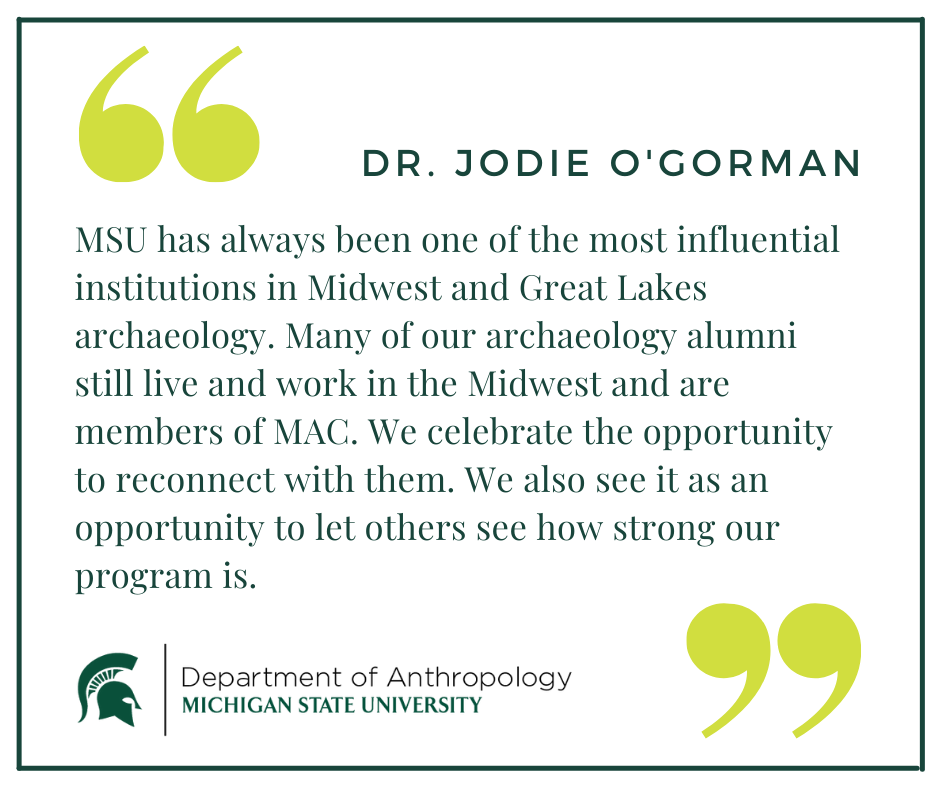
    “MSU has always been one of the most influential institutions in Midwest and Great Lakes archaeology,” O’Gorman said. “Many of our archaeology alumni still live and work in the Midwest and are members of MAC. They hold some of the most influential archaeology positions in national, state, and private organizations. We celebrate the opportunity to reconnect with them. We also see it as an opportunity to let others see how strong our program is.” 

    The meeting this year was a joint meeting with the Midwest Historical Archaeology Conference because O’Gorman and her colleagues decided to co-host this meeting to stress the importance of both kinds of archaeology at MSU. The co-organizers were Drs. Jessica Yann and Stacey Camp, Director of MSU’s Campus Archaeology Program. 

    “I hope people enjoyed reconnecting with colleagues. Some of the papers reflect on archaeology in the time of COVID, and I think it’s important for us to share that and to support each other,” O’Gorman said. “I think people also enjoyed just getting back to a bit of normalcy in terms of hearing research papers.”

    Attendees attended sessions, workshops and a Campus Archaeology tour of MSU.

    “One unique event was the MAC-sponsored symposium I co-organized with several former and current students,” O’Gorman said. “We assembled 13 papers on ‘Midcontinental Cuisine: Recent Archaeological Explorations of Food and Cooking in the Heartland,’ about cuisine from ancient times to MSU’s early history. We also featured MSU historical cuisine at the following reception in collaboration with MSU chefs.” 

    Other events during the conference were a workshop on building an inclusive culture in the field, and two workshops (one for students and one for practicing archaeologists) on 3D Digitization, Preservation, and Access in Archaeology and Heritage. The 3D workshops were presented by Dr. Ethan Watrall in the college’s Lab for the Education and Advancement in Digital Research (LEADR), an interdisciplinary venture of Anthropology, History, and Matrix. 

    “The past cultures we study lived from the edge of the Plains into the forests of the Northeast, around the Great Lakes as well as smaller inland lakes, and along major and minor river valleys,” O’Gorman said. “Indigenous groups have been here since at least 15,000 years ago and their cultural heritage is especially rich and varied.”

    Hosting the conference had special meaning to O’Gorman.

    “I first became interested in MSU when I attended a MAC meeting here 22 years ago,” O’Gorman said. “That meeting led to my application for the position I hold now. As I think about retirement, I hope the younger generation of Midwest archaeologists that attended this year saw what an exciting program we have.” 

    To learn more about the Midwest Archaeology Conference, visit https://www.midwestarchaeology.org/about .

  • Dr. Najib Hourani Receives Dean’s Diversity, Equity and Inclusion Faculty Award

    Photo of Dr. Najib Hourani

    Dr. Najib Hourani, an associate professor in the Department of Anthropology and the Global Urban Studies Program and core faculty in the Muslim Studies Program, is the winner of the inaugural 2021 College of Social Science Dean’s Diversity, Equity, and Inclusion Excellence Faculty Award. The award recognizes social science faculty who have made comprehensive, impressive and sustained efforts surrounding diversity, equity and inclusion.

    “Dr. Hourani is richly deserving of the inaugural DEI Faculty award because he has a demonstrated and sustained record of making our campus a safe, inclusive, and welcoming environment for all,” said Dr. Nwando Achebe, the Associate Dean of Diversity, Equity, and Inclusion for the College of Social Science.

    Continuing a tradition of transformative research

    Dr. Hourani joined MSU’s faculty in the fall of 2006, and quickly established himself as a campus expert on the political anthropology of the Middle East, civil conflict, and cities of the Arab world. His past research focused on the Lebanese civil war and post-conflict urban reconstruction, and his current research builds upon the lessons learned in Beirut to address the rebirth of Syrian cities as that country’s decade-long civil war comes to an end. 

    Unable to visit Syria due to U.S. travel restrictions, Dr. Hourani was recently awarded a Fulbright Fellowship to work with Syrian refugees in the neighboring country of Jordan to better understand their needs, hopes and aspirations for returning to their home villages, towns and cities.

    Though his work in Jordan ended prematurely due to the COVID-19 pandemic, Dr. Hourani is still finding ways to transform the human experience through his scholarship closer to home. Teaming up with faculty from Global Studies in Arts and Humanities in the College of Arts and Letters, Dr. Hourani is exploring new research on the relationship between African American and Arab American communities in the United States. 

    “The relationship between these two communities has historically been complicated, as there have been periods of both conflict and allyship between these groups in the past,” Dr. Hourani explained. 

    Creating space for DEI conversations in the classroom 

    On top of his research, Dr. Hourani teaches several undergraduate and graduate-level Anthropology courses. Upon his arrival at MSU, he developed the Anthropology of the Middle East course, which, in addition to exploring the peoples and cultures of the region, begins with discussions of race and representation. “There are a lot of stereotypes and misconceptions about what it means to be Arab that many people carry with them that they may not even realize,” explained Dr. Hourani.

    In his classes, Dr. Hourani believes in fostering conversations about race and identity rather than shying away from them. For example, Dr. Hourani helps students to recognize harmful portrayals that normalize bigotry against Arab people in US popular culture, and encourages them to engage with such portrayals critically.

    Dr. Hourani emphasizes the incredible opportunity that Spartan students have to learn about Arab culture, heritage and history at MSU – especially from Arab American faculty. 

    “Many people may not realize that, outside of the Middle East, Michigan has the largest Arab population in the world,” Dr. Hourani explained. “Arabs and Arab Americans have made tremendous contributions to the state and to the country. In an increasingly diverse country, it is important for students to learn about Arab peoples and cultures. Unlearning biases and stereotypes is hard work. I am gratified to see so many students willing to take it on at MSU.”

  • PhD Student Marwa Bakabas named diversity torch for MSU College of Social Science

    Department of Anthropology doctoral student Marwa Bakabas was featured as the Diversity Torch in the College of Social Science “Diversity Matters” issue for Arab American Heritage Month. Arab American Heritage Month commemorates the contributions of Arab Americans to American life and their struggles to receive full protections as American citizens. The College of Social Science Diversity Torches celebrate students who uphold a diversity value or ideal. As “Diversity Torches,” they provide light, guidance, and awareness to their fellow students and all who see them.

    Marwa Bakabas is a sociocultural anthropology PhD student in the Department of Anthropology whose work centers on violence, forced migration, exile, and trauma in the Middle East. While writing her Master’s thesis in Lebanon, Marwa decided she wanted to apply for a PhD and expand her focus from studying refugees that are displaced in Lebanon and Greece to also include the Yemeni refugee community. Marwa explains that MSU was a great fit because they had more opportunities to both become an academic practitioner and to continue work as an activist. Her dissertation will focus on the visibility of the war and conflict in Yemen and the subsequent displacement/exile of Yemenis.

    In both her personal and professional life, Marwa is inspired by the Arab Americans making a difference in their communities, noting “as Arab-Americans, we have a choice in how we embrace or neglect our identity and so many of my counterparts and friends that I have crossed paths with have inspired me, especially those who continue to preserve our traditions while helping spread awareness and knowledge to break stereotypes.”

    Marwa also explains, “We can all be better allies by standing in solidarity with one another. Many groups face marginalization and racism in America and all over the world. We need to stand together and build stronger allyship instead of amplifying our differences.”

  • Dr. Heather Howard and doctoral student Livy Drexler awarded Spencer Foundation Grant

    Department of Anthropology Associate Professor Heather Howard and doctoral student Livy Drexler have been awarded a grant from the Spencer Foundation to carry out research for the project, “Special Education in Indian Country: Challenges and Insights from Applying Indigenous Models of Disability in Schools.” Indigenous children are overrepresented in special education programs and are 15% more likely than other groups to be tracked into special education programs. Yet, there has been little examination of the experiences of Indigenous students in special education nor of the intersection of Indigenous and disability identities. The research will explore this intersectionality by examining if there are culturally specific and appropriate Indigenous disability models which shape Indigenous students’ experiences of special education and provide insights for improving how models of disability are applied in Indigenous education settings. This study will uniquely engage disability critical race theory and critical Indigenous theory to understand the intersecting identities of disability and Indigeneity to provide a fuller understanding of Indigenous disability frameworks, and how these frameworks map with and against Western conceptions and understandings of disability. 

    The Spencer Foundation’s goals include investing in “research that is transformative, methodologically rigorous, and helps create a better society” while supporting “high-quality education research training… the diversity of scholars and scholarship in education research (to) strengthen the impact of education research for improving educational practice.” The $47,000 investment from the Spencer Foundation will support ethnographic fieldwork which will be conducted by Livy Drexler. Livy Drexler is an anthropology PhD candidate at MSU, a former special education student, and an older sibling to two autistic brothers. As a result of their background, Drexler will be able to contribute a unique and important perspective to this project. They will be guided by Indigenous methodological principles of knowledge production and the project will provide the participant communities with an informational resource for improving the education experience of Indigenous children in special education. Howard and Drexler are also delighted to collaborate with Dr. Troy Mariage who is serving as a consultant for this project. Mariage is an associate professor of special education in MSU’s counseling, educational psychology, and special education department. 

  • Dr. Carolyn Isaac, doctoral student Clara Devota, and MSU Anthropology alumni publish in the International Journal of Legal Medicine on an online database for skeletal injuries

    Department of Anthropology Assistant Professor Dr. Carolyn Isaac, doctoral student Clara Devota, and MSU Anthropology alumni Dr. Jered Cornelison and Erica Christensen, M.S., recently published an article in the International Journal of Legal Medicine entitled: “The Repository of Antemortem Injury Response (REPAIR): an online database for skeletal injuries of known ages”. The article discusses the importance of The Repository of Antemortem Injury Response (REPAIR) as a reference for forensic casework, an educational tool, and database for research on dating fractures and healing rates.

    Read the full article at: https://rdcu.be/cEyZy

    Abstract: “An accurate assessment of time since fracture is an essential component of abuse and death investigations; however, little evidence-based research exists on dating fractures, especially those of the cranial vault. This is primarily due to difficulties in procuring human fracture specimens of known posttraumatic survival times. The aim of this article is to introduce a new database through which limitations imposed by sample procurement may be mitigated. The Repository of Antemortem Injury Response (REPAIR) is a digitally accessible database of cranial vault fractures of known ages with extensive contextual information and visual documentation in the form of photography, radiography, and histological photomicrographs. This repository is a multifunctional tool that serves as a case submission portal for cranial fractures of known posttraumatic survival time, a sample database for research on fracture healing and rates of repair, a resource for comparative assessments of cranial fractures in forensic casework, and an educational tool for healing fracture histomorphology.”

  • Dr. Gabriel Wrobel publishes two articles in Ancient Mesoamerica on Maya Skeletal Remains

    Department of Anthropology Associate Professor Gabriel Wrobel recently published two co-authored articles in Ancient Mesoamerica as part of a special issue called “The Preceramic and Early Ceramic Periods in Belize and the Central Maya Lowlands.” Ancient Mesoamerica is a flagship journal for Mesoamerican archaeology published by Cambridge Press, and both articles are open access, through an agreement between the MSU Library and Cambridge Press. 

    The first article is titled “Life And Death Among The Earliest Maya: A Review Of Early And Middle Preclassic Burials From The Maya World”, and is co-authored by Dr. Raúl Alejandro López Pérez (Universidad Autónoma de Yucatán), and Dr. Claire Ebert (University of Pittsburgh). It discusses the earliest Maya skeletal remains and the need for coordinated research into the biology of early groups.

    Read the full article at: https://doi.org/10.1017/S0956536121000456

    Abstract: “This article presents a review of the earliest Maya skeletal remains thus far found, including a list of 398 burials dating to the Early (1800–900 B.C.) and Middle Preclassic periods (900–300 B.C.) and adjacent regions. These sites are spread throughout the Maya region and the data allow basic descriptive syntheses about early mortuary behavior and aspects of health and diet. Poor preservation and differences in scoring and reporting severely limit the scope of interpretation possible at this point, but it is hoped that this review stimulates coordinated research into the biology of early groups.”

    The second article is titled “Before The Maya: A Review Of Paleoindian And Archaic Human Skeletons Found In The Maya Region” and is co-authored by Dr. Julie Hoggarth (Baylor University), and PhD student Aubree Marshall. This article discusses skeletal remains found in Mexico and Belize dating to the Paleoindian and Archaic periods.

    Read the full article at: https://doi.org/10.1017/S0956536121000250

    Abstract: “This article presents a review of the earliest known skeletal remains in the Maya area, which are found in submerged caves in Mexico and rock shelters in Belize and date to the Paleoindian and Archaic periods. While few in number, several of these individuals have been the focus of intensive analyses, providing an emerging picture of life in the region before the transition to agriculture and settled village communities.”

  • The MSU Forensic Anthropology Lab moves to Giltner Hall

    Alexis Goots and Micayla Spiros discuss some x-rays with anthropology faculty member Carolyn Isaac in the new MSU Forensic Anthropology Lab in Giltner Hall.

    During the summer of 2021, the Michigan State University Forensic Anthropology Lab (MSUFAL), moved from its longtime home in East Fee Hall to a new laboratory and teaching space in Giltner Hall. The move has been bittersweet, due to the history of groundbreaking research and fruitful collaborations that were forged in East Fee Hall, but the new lab in Giltner offers the opportunity to expand the consulting, training, and research for which MSUFAL is known.

    The MSUFAL has been an integral part of the MSU landscape since the 1970s, providing a variety of forensic services including forensic archaeological recovery, decedent identification, trauma analysis, and expert witness testimony. The lab has provided these services for diverse types of cases such as positive identification of unidentified human remains, human skeletal analysis, trauma analysis, human vs. nonhuman bone, and field search and recovery. The forensic anthropology faculty comprises Dr. Todd Fenton, who is currently serving as Department Chair until 2024, Dr. Joe Hefner, and Dr. Carolyn Isaac, the current lab director.

    From the late 1970s to the late 1990s, the MSUFAL, under the direction of Dr. Norm Sauer, was housed in the basement of an administration building on campus, which offered very little analytical space and only one small sink. During this time, most of MSUFAL’s work was done at the local morgue, as the on-campus laboratory facilities were not conducive to forensic casework. In the mid-1990s, the MSUFAL moved to its most recent home in East Fee Hall, where the larger space and the addition of Dr. Fenton to the faculty allowed casework, teaching, and research efforts to substantially expand.

    Throughout the two decades during which the MSUFAL called East Fee Hall home, members of the MSUFAL participated in trauma research, ancestry research, bioarchaeology projects and dissertations, skull-photo superimposition, forensic image comparisons, and countless forensic cases. In addition, the location in East Fee Hall allowed for close collaboration with the anatomy department, medical school, and biomechanical engineers, all of whom also had labs in the building. While the MSUFAL was housed in East Fee Hall, MSUFAL faculty and graduate students consulted on over 1,200 forensic cases, averaging approximately 60 forensic cases per year. Further, over the past 14 years, MSUFAL faculty have garnered over $5,000,000 in external research funding, cementing MSUFAL as one of the premier forensic anthropology research laboratories in the country.

    Given MSUFAL’s expanding faculty, increasing casework, and new research initiatives, and despite the great success of students and faculty over the last five decades, it became clear that the lab had finally outgrown the space in East Fee Hall. In May 2021, faculty and students packed up the laboratory and moved to a beautiful new space in Giltner Hall. This move was motivated by the prospect of a larger space and being in the same building as the other physical anthropologists, as well as Giltner’s proximity to the rest of the department in Baker Hall.

    Alexis Goots works in the new MSU Forensic Anthropology Lab in Giltner Hall.

    The new lab space in Giltner Hall has proven to be an upgrade in many ways, with its centralized location being perhaps the greatest advantage. Instead of the disparate lab spaces of East Fee, the new Giltner lab boasts a connected dry lab, wet lab, radiography and photography space, grad student office, lab director office, and a large classroom. Overall, the new lab is an ideal place to conduct sensitive casework, safely and securely house skeletal material, conduct meaningful research, and train the next generation of forensic anthropologists!

  • Department Statement on RVSM and Title IX

    Please Note: This statement refers to events that may trigger traumatic memories for members of our community. Resources and assistance are available through the Center for Survivors1, MSU Safe Place2, Counseling and Psychiatric Services3 and the Employee Assistance Program4

    The Department of Anthropology is committed to fostering an inclusive, safe, and welcoming  environment where all faculty, staff and students are valued, respected, and celebrated. Foremost in our priorities is the physical and emotional safety of our students, faculty, and staff. We also validate and stand by survivors of sexual harassment and misconduct, sexual  abuse, and relationship violence; recognizing that all too often their voices are not heard and  their stories not believed1. We know that it is our responsibility to not only listen to survivors, but also to serve as active bystanders, willing to intervene when we observe actions that threaten our community’s safety and violate our deeply held beliefs.  

    As such, we acknowledge the seriousness of RVSM and Title IX violations in the university and  are committed to taking action with regard to the violations that arise in our department, including our classes, offices, labs, and field schools. We do this while following all department,  college, and campus policies and procedures, including the Anti-Discrimination Policy (ADP)5, Relationship Violence and Sexual Misconduct (RVSM)6, Mandatory Reporting7, and Pregnant and Parenting Student policy8

    Training and education on campus policies has been and continues to be taken seriously in the Department of Anthropology. All faculty and staff are current in their required RSVM training as  mandated by MSU; however, we recognize that it is our responsibility to ensure that everyone  in our department knows how to put this training into practice. We have proactively taken  continuing educational measures for faculty through participation in a Prevention, Outreach, and Education (POE)9 workshop on Monday, January 25, 2021. At this time, we ask that all  faculty, staff, and students review RVSM and Title IX policy terms and examples10 and reporting  requirements11. We also remind all faculty and staff members that any sexual misconduct  divulged to them in the context of their position must be reported to the Office of Institutional  Equity (OIE)12 as per university policy.  

    Furthermore, we encourage anyone who has experienced discrimination, harassment, or  retaliation to contact the OIE. Any individual who experiences conduct that violates the criminal law is encouraged to contact MSU Police13 and local law enforcement. Michigan State  University also provides Confidential Resources14 free of charge where those who experienced relationship violence or sexual misconduct may explore their options, talk about what happened, and obtain support services. The Department of Anthropology has and will continue  to prioritize a healthy and safe environment for students, staff, and faculty, while striving for diversity, equity, and inclusion. Misconduct of any sort is unacceptable as is the silencing of any victim. It is our duty to unite and raise awareness to enhance the safety and proper conduct of  our university. 

    We see our commitment to providing a safe environment as part of our larger departmental efforts to increase and sustain diversity, equity, and inclusion. The diversity that each and every  one of us brings to the department and to the university is immense, and a source of our  strength. We recognize that making spaces safe and welcoming is utmost in fostering an inclusive culture.  

    Todd Fenton, Chair and Professor 

    Mindy Morgan, Graduate Program Director 

    Resources: 

    1Center for Survivors  

    https://centerforsurvivors.msu.edu/education-resources/index.html

    2MSU Safe Place 

    https://safeplace.msu.edu/

    3Counseling and Psychiatric Services 

    https://caps.msu.edu/

    4Employee Assistance Program 

    https://eap.msu.edu/

    5Anti-Discrimination Policy (ADP) 

    https://www.hr.msu.edu/policies-procedures/university-wide/ADP_policy.html

    6Relationship Violence and Sexual Misconduct and Title IX Policy

    https://civilrights.msu.edu/policies/relationship-violence-and-sexual-misconduct-and-title-ix-policy.html

    7Mandatory Reporting 

    https://civilrights.msu.edu/policies/reporting_protocols.pdf

    8Title IX of the Education Amendments of 1972: Pregnant and Parenting Student Information

    https://civilrights.msu.edu/policies/index.html#

    9Prevention, Outreach and Education Department 

    https://poe.msu.edu/programs/index.html

    10Terms 

    https://poe.msu.edu/resources/rso%20handbook%20draft.pdf

    11Reminder regarding faculty reporting:  

    https://poe.msu.edu/resources/Faculty-Staff2020.pdf

    12Office of Institutional Equity 

    https://civilrights.msu.edu/file-a-report/index.html

    13MSU Police 

    https://police.msu.edu/contact/report-a-crime/

    14Confidential Resources 

    https://civilrights.msu.edu/file-a-report/confidential-resources.html

    Additional Resources: 

    Heath-Stout, Laura E. (2020) Who Writes about Archaeology? An Intersectional Study of  Authorship in Archaeological Journals, American Antiquity, Volume 85, Issue 3, July 2020, pp.  407 – 426. https://doi.org/10.1017/aaq.2020.28 

    Voss, Barbara L. (2021a) Documenting Cultures of Harassment in Archaeology: A Review and  Analysis of Quantitative and Qualitative Research Studies, American Antiquity, Volume 86, Issue  2, April 2021, pp. 244 – 260. https://doi.org/10.1017/aaq.2020.118 

    Voss, Barbara L. (2021b) Disrupting Cultures of Harassment in Archaeology: Social Environmental and Trauma-Informed Approaches to Disciplinary Transformation, American  Antiquity, Volume 86, Issue 3, July 2021, pp. 447 – 464. https://doi.org/10.1017/aaq.2021.19

  • Dr. Heather Howard-Bobiwash team awarded Robert Wood Johnson Foundation Public Policy Research to Advance Racial Equity and Racial Justice grant.

    MSU investigators Claire Margerison (Department of Epidemiology & Biostatistics), Danielle Gartner (Department of Epidemiology & Biostatistics, Sault Ste. Marie Tribe of Chippewa Indians) and Heather Howard-Bobiwash (Department of Anthropology) were recently awarded a grant under the Robert Wood Johnson Foundation Public Policy Research to Advance Racial Equity and Racial Justice program for their proposal entitled “Assessing whether Indigenous women of reproductive age had equitable access to and use of health care under the Affordable Care Act.” As a group, Indigenous pregnant and birthing persons experience high rates of morbidity and mortality while they also often hold citizenship in sovereign Indigenous Nations with whom the United States has agreements of fiduciary responsibility. In partnership with an advisory board of Indigenous health services and policy experts, this project will combine qualitative and quantitative research analyzing national datasets and interviews with expert consultants to provide understanding of how to make federal health policy work equitably for Indigenous people in the US.